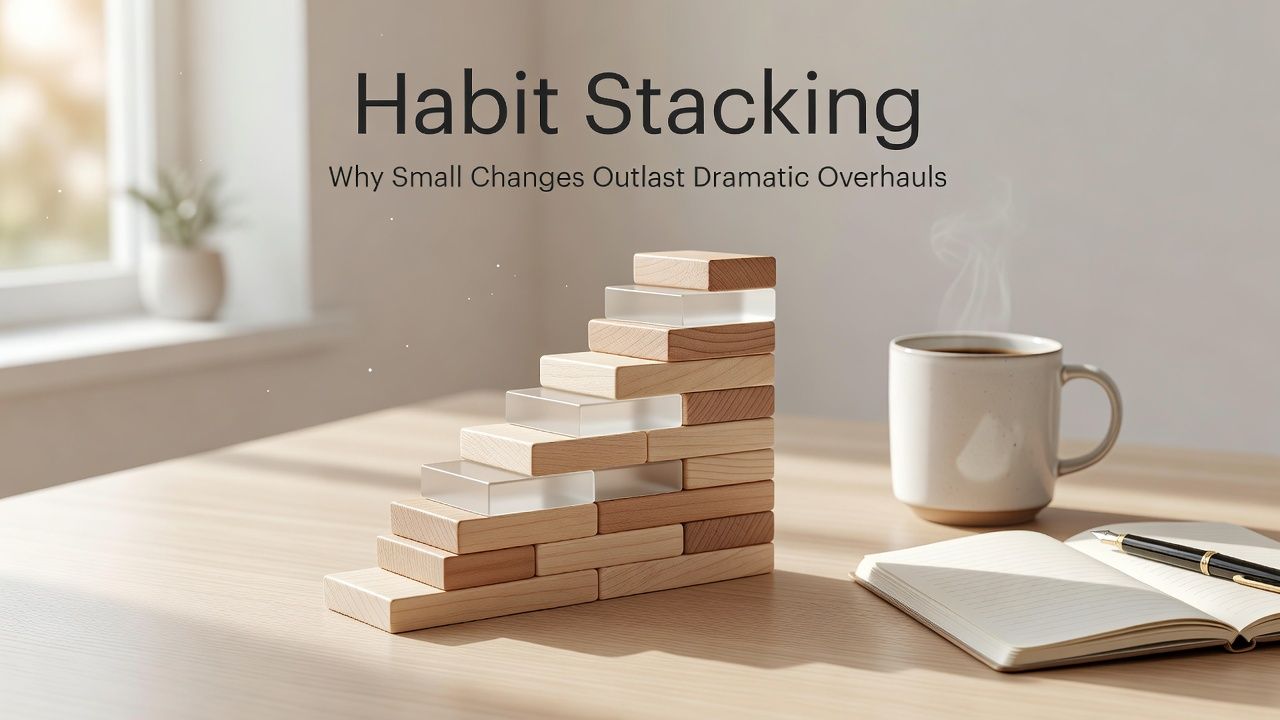
The person who adds one two-minute habit to an existing routine will be running it in a year. The person who redesigns their whole life on January 1st will be back to normal by February. This is the mechanics of why.
Every January, millions of people make the same bet: that this time, motivation will be enough. The gym contract, the meal plan, the 5 a.m. alarm, the whole gleaming overhaul. And every February, the same quiet surrender. The failure rate of New Year’s resolutions has been measured at somewhere around eight in ten by most estimates, and yet the overhauls keep getting attempted, because the alternative, tiny changes attached to existing routines, doesn’t feel like transformation. It feels like nothing. That feeling is exactly the advantage.
The research on behavior change has converged on an unglamorous conclusion: dramatic change fails because it depends on motivation, and motivation is weather. Habits succeed because they run on context, and context is climate. Habit stacking, attaching new behaviors to routines you already perform without thinking, is the most practical expression of that finding. It won’t give you a new personality by March. It’ll give you new defaults by summer, which is better, because defaults are still there in December.
Why the Overhaul Fails Motivation is a spark, not a fuel
The anatomy of a failed overhaul is always the same. Day one, motivation is at maximum: the alarm, the workout, the salad, the journaling, all of it, powered by fresh resolve. Week two, the resolve is now competing with a bad night of sleep, a deadline, a sick kid. The overhaul’s problem is structural: it requires a dozen simultaneous acts of will, every day, indefinitely. Willpower is a real but limited and fluctuating resource, and any system that needs it at peak capacity forever has a built-in expiration date. Miss enough days and the shame kicks in, which completes the cycle: the failed overhaul doesn’t just fail, it teaches you that change doesn’t work for you. The damage is the lesson, not the lapse.
The NIH’s own coverage of why habits are so hard to change makes the key point: habits aren’t decisions, they’re learned loops triggered by context, which is why they survive motivation’s weather. Fighting them head-on with resolve is attacking the wrong layer. The layer to work on is the trigger structure itself. That’s where stacking lives.
The Habit Loop, in Plain Terms Cue, routine, reward
Strip a habit down and it has three parts: a cue (the trigger, a time, place, feeling, or preceding action), a routine (the behavior), and a reward (whatever closes the loop in your brain). Repeat the loop in a stable context and the brain gradually moves it out of deliberate control and into autopilot. How long? The most-quoted study, which tracked people building everyday habits like drinking water with lunch, found a median around sixty-six days to automaticity, with a wide range from a few weeks to most of a year depending on the behavior’s complexity. Simple stacks automate in weeks. Ambitious ones take seasons. Anyone promising twenty-one days is selling you a slogan from the 1960s.
Two implications fall out. First, you can’t shortcut repetition; the practice is the program. Second, and this is the encouraging part, missing a single day doesn’t reset the clock. The research showed occasional lapses didn’t derail automation at all. The habit isn’t a streak to protect. It’s a groove being worn into your days, and grooves don’t vanish because of one skipped Tuesday.
Stacking: The Mechanics After X, I will Y
Habit stacking exploits the strongest cue you own: the routines already running on autopilot. You don’t remember to brush your teeth through discipline; the bathroom and the morning trigger it. Stacking pins the new behavior to that existing trigger with an explicit formula: “After [current habit], I will [new habit].” After I pour my coffee, I will take my vitamins (which now live next to the coffee). After I sit down at my desk, I will write one sentence of the report. After I brush my teeth, I will do thirty seconds of balance practice. The technique’s research parent is the implementation intention, if-then plans that have shown robust effects on follow-through across dozens of studies, because they pre-decide the when and where, removing the two moments where most intentions die.
The craft details matter. The anchor must be specific and daily (“after lunch” beats “in the afternoon”; “after I start the coffee maker” beats “in the kitchen”). The new behavior must be attached immediately, not eventually. And one stack at a time: the temptation to bolt six new habits onto your morning is just the overhaul in a trench coat, and it ends the same way.
The Two-Minute Rule Shrink the entry, grow later
The most counterintuitive instruction in behavior change: make the new habit absurdly small at the start. Not “read for an hour” but “read one page.” Not “meditate twenty minutes” but “sit and take three breaths.” This isn’t a gimmick for the weak-willed; it’s sound engineering. The early phase of habit building is about establishing the loop, cue fires, behavior happens, and any friction in the behavior threatens the loop. A one-page read survives your worst day. An hour of reading doesn’t. The version of the habit that exists on your worst day is the only version that compounds.
Expansion happens naturally once the loop is automated: the page becomes a chapter because you’re already reading, and nobody needs to be talked into continuing something they’ve started. Starting is the entire battle. Think of the tiny version not as the goal but as the doorway, and judge it only by whether it gets you through the door daily. The floors of the house get built later, almost without noticing.
Environment Design Willpower’s quiet replacement
Every habit researcher eventually says the same sentence: you’ll rise or fall to the level of your environment, not your intentions. The cue doesn’t have to be a routine; it can be an object, placed in your path. The vitamins by the coffee maker. The walking shoes by the door, laces open. The book on the pillow, which makes reading the path of least resistance at the exact moment the phone wants your attention. The guitar on a stand in the living room instead of zipped away in its case in the closet; people who made that one move report practicing multiples more, and nothing about their discipline changed at all.
The inversion works identically for habits you’re retiring: add friction. Move the snacks to the high shelf, log out of the app, leave the TV remote in a drawer. Twenty extra seconds of effort is often enough to flip a behavior, because autopilot chooses the easy path, and you control which path is easy. Design beats discipline so reliably that after a while you stop thinking of yourself as a person with willpower at all. You’re a person with a well-arranged kitchen. It works better.
The Compounding Logic Why small is secretly big
The case for tiny habits isn’t just that they survive. It’s that they compound in two ways the overhaul never does. First, behaviorally: each automated habit becomes a new anchor, so stacks accrete. The person who stacked one push-up after brushing their teeth in March has, by September, a small morning circuit, and none of it required a decision, because each addition rode an established groove. Second, psychologically: small kept promises rewrite identity. “I’m someone who does the thing” is built from evidence, and two minutes of daily evidence, accumulated for months, outweighs any amount of January resolution. The identity shift is the deep mechanism; once “I’m a person who walks after lunch” is simply true about you, the habit no longer needs management. It’s just what happens after lunch.
This is also why the overhaul’s collapse is so corrosive and the stack’s success so quiet. The overhaul promises a new you and delivers evidence you can’t change. The stack promises nothing and delivers evidence you can. One of those is a sustainable relationship with self-improvement.
Breaking Bad Habits: The Inversion Same machinery, opposite direction
Unwanted habits run on the same loop, so the tools invert cleanly. You can’t easily delete a habit (the groove persists), but you can attack each component. Expose the cue: for a week, just notice what triggers the behavior, time, place, feeling, preceding action. Most people have never actually watched their own trigger; the noticing alone begins to weaken the automaticity. Add friction to the routine: the twenty-seconds rule, the high shelf, the logged-out app. Replace rather than remove: the loop wants a routine, so give it a cheaper one, the after-dinner scroll becomes the after-dinner walk, which answers the same restlessness cue with a different script. Pure subtraction leaves the cue firing into a vacuum, and vacuums get filled by the old habit the moment willpower dips.
And patience, again, calibrated by the research: unwinding a groove takes roughly as long as cutting one. The stress of fighting a habit also feeds it when the habit is a stress response, which is the vicious circle behind most “bad” habits. The APA’s stress resources are relevant here for a reason: treat the underlying stress and half the habit’s fuel supply disappears with it.
Never Miss Twice The recovery protocol
You will miss days. Travel, illness, chaos, the habit doesn’t care about your reasons. What determines survival is not the miss but the response to it, and the protocol is one line: never miss twice. One miss is noise, an accident, nothing. Two misses is the beginning of a new pattern, and the brain is exquisitely sensitive to which pattern it thinks we’re building now. So the rule creates a hard floor: after any miss, the very next opportunity is non-negotiable, even in comically reduced form. Three breaths. One page. One push-up. The point isn’t the dose; it’s the message to the groove: this is still what we do.
Banish the streak mentality while you’re at it. Streaks feel motivating right up until they break, at which point they convert a single missed day into a total failure and an excuse to abandon everything. Track if tracking helps you, but track months and years, not unbroken chains. The target was never perfection. It’s a behavior that reliably reappears, like a river after a drought, because the channel is still there.
The Reward Problem Closing the loop on purpose
Good habits suffer from a design flaw: their rewards are delayed. The walk pays off in six months; the couch pays now. Since the loop closes on reward, and autopilot only forms around loops that close, you sometimes have to bolt on an immediate, honest reward while the real one matures. This is not cheating; it’s the mechanism. The checklist tick (genuinely effective; your brain loves completion signals), the small ritual afterward, the tracking app, the friend you report to. Anything immediate that marks the loop as closed and good.
Celebration, the tiny internal “yes” right after the behavior, turns out to matter more than it sounds. Emotion wires habits; the behavior that ends in a flicker of satisfaction gets rehearsed by the brain, and the one that ends in nothing gets quietly dropped. You don’t have to throw a parade for flossing. A beat of acknowledgment, “done, that’s who I am,” is enough. Corny, brief, and neurological.
The Anchor Inventory Where to find your hooks
Stuck on what to stack onto? You already own dozens of anchors; you just haven’t inventoried them. Morning: alarm off, feet on floor, coffee started, teeth brushed, shower ended. Workday: computer opened, first meeting ended, lunch finished, laptop closed. Evening: door unlocked, dinner finished, dishes done, kids in bed, pajamas on, head on pillow. Each is a daily, automatic, reliably-timed event, which is the complete specification for a cue. The common mistake is anchoring to things that don’t happen daily (weekend-only anchors make weekend-only habits) or to vague states (“when I have energy”). Concrete beats vague; frequent beats occasional; physical beats mental.
Choose anchors by adjacency, too: the new behavior should live near the anchor physically and logically. Vitamins stack onto coffee because they can sit beside the machine. Balance practice stacks onto tooth-brushing because both happen barefoot in the bathroom. A stack that requires crossing the house is a stack with friction built in, and friction, as established, is destiny.
A Twelve-Week Stacking Plan The whole method, applied
Weeks one to three: one stack only, and I mean exactly one. Pick the highest-leverage tiny habit (for most people it’s sleep, movement, or the phone), attach it to the strongest anchor in your day, in its two-minute form, with the object pre-placed. Do nothing else. You’re proving the loop. Weeks four to six: add the small immediate reward and the never-miss-twice rule; the first habit should be feeling automatic now, and you may add one more stack, one, onto a different anchor. Weeks seven to twelve: let the first habit grow naturally (the page becomes the chapter), keep the second small, and audit: which stacks are firing without thought? Those are done; they’re yours now.
At twelve weeks you’ll have two to four new defaults running on their own and, more valuable, a method that you trust and can reuse for the rest of your life. That’s the real asset. The overhaul asks you to believe in a new you. Stacking just asks what happens after you pour the coffee, and then it answers, quietly and reliably, for years and years.
This article is general education, not medical or psychological advice. Sources linked above include the National Institutes of Health and the American Psychological Association. This article contains no affiliate links and no product recommendations. All outbound links checked live in August 2026.