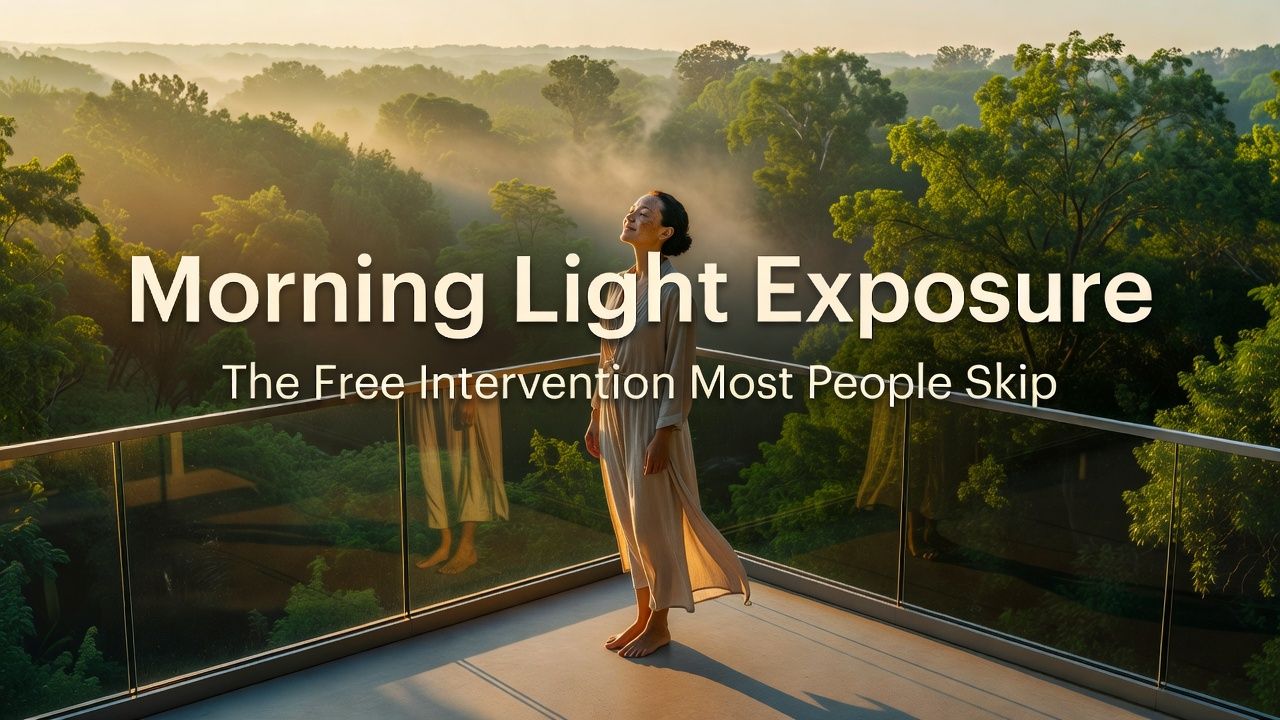
Ten minutes of outdoor light before your first email does more for tonight’s sleep than anything you’ll buy. The mechanism is a clock in your brain that’s been waiting for the signal all morning.
Here’s the average modern morning: alarm in a dark bedroom, straight to a glowing phone held six inches from the face, then a commute or a desk, indoor light all day, and then, at 11 p.m., sincere confusion about why sleep won’t come. We’ve built a lighting environment that would baffle any previous generation of humans: dim days and bright nights, the exact inverse of the pattern our biology expects. And we wonder why the machinery runs badly.
The correction costs nothing, requires no equipment, and takes about as long as making toast: get outside into daylight within an hour or so of waking. The research and clinical consensus behind this is unusually strong for a free intervention, and the benefits show up in the two places people care about most: falling asleep more easily at night and feeling more alert during the day. This article explains the clock it works on, the dose that matters, the mistakes that neutralize it (yes, the window counts against you), and how to build it so it survives November.
The Clock You’re Setting A quick tour of the SCN
Deep in your brain sits a pea-sized cluster of neurons called the suprachiasmatic nucleus, the master clock of the circadian system, and its job is to run your twenty-four-hour program: when to release alerting hormones, when to start the melatonin that makes you sleepy, when body temperature peaks and dips. The crucial fact about this clock: it doesn’t run on exactly twenty-four hours. Left without input, it drifts. What sets it correctly each day, what winds the watch, is light hitting specialized cells in your eyes, cells that don’t help you see but exist specifically to tell the clock what time it is outside.
The Sleep Foundation’s circadian rhythm explainer covers this system well, and the NHLBI’s sleep science pages describe the two-process model that governs sleepiness: the circadian clock plus building sleep pressure. The practical upshot of all this biology is a single sentence: morning light is the input your clock uses to schedule tonight’s sleepiness. No input, or input at the wrong time, and the schedule drifts late. You feel it as lying in bed at midnight, tired but not sleepy, wondering what’s wrong with you. Nothing’s wrong with you. Your clock just never got set.
Why Morning Specifically The timing asymmetry
Light affects the clock at any hour, but the direction of the effect depends on when it arrives. Light in the morning pushes your rhythm earlier (a phase advance): melatonin starts earlier tonight, sleepiness arrives on time, waking tomorrow gets easier. Light in the late evening pushes later (a phase delay), which is the story of every person scrolling a bright screen at midnight and then unable to sleep at one. Same light, opposite effects, purely by timing. This asymmetry is why “get more light” is incomplete advice and “get light early” is the precise version.
There’s a second reason morning wins: it starts the day’s alerting chemistry on schedule. That cortisol pulse people worry about is, in the morning, a feature, it’s part of how you wake fully and feel sharp, and morning light amplifies it appropriately. Daytime alertness and nighttime sleepiness are the same program viewed from two ends. Set the morning and the evening follows.
The Dose Minutes, clouds, and the window problem
The numbers, with the honesty about ranges they deserve. On a clear sunny day, roughly five to ten minutes outdoors is a solid dose. Under overcast skies, fifteen to thirty. The brightness difference between indoor and outdoor light is so extreme, hundreds of times, even under clouds, that “but it was grey” is no excuse; a gloomy morning outdoors still delivers multiples of what your well-lit kitchen provides. No sunglasses for the dose, no staring at the sun (never; you don’t need to, the sky itself is the signal), and no glass in between.
That last point kills the most common workaround: windows block a large share of the relevant light, so sitting by a sunny window is a fraction of the dose, and a car windshield during the commute is similarly compromised. The dose wants you actually outside. This is the only non-negotiable in the whole practice, and it’s why the suggestions that work best all involve crossing a threshold: stepping onto the balcony with the coffee, walking the dog, walking to the farther bus stop, parking at the far end of the lot. You don’t need to “do” anything in the light. You just need to be in it, eyes open, living your morning.
What the Evidence Shows Sleep, mood, alertness
Daytime light exposure shows up in sleep research with consistent findings: people who get more bright light in the morning and across the day fall asleep faster, sleep more solidly, and report better daytime alertness. Office-worker studies comparing window-adjacent desks to interior ones found meaningful differences in sleep duration and quality, the daylight was doing quietly, through a workday, what sleep hygiene checklists strain to do deliberately. On the mood side, bright light exposure has real evidence for improving depressive symptoms, which is why bright-light therapy is a mainstream, guideline-supported treatment for seasonal depression and a studied adjunct for non-seasonal depression too.
Calibrate expectations honestly: this is a lever, not a cure. Morning light will not fix insomnia caused by apnea, grief, or a newborn, and it doesn’t outrank the fundamentals (consistent wake time, sane caffeine timing, a dark cool room). What it does is make every other sleep intervention work better, because they’re all downstream of a clock that’s set correctly. It’s the first domino. The CDC’s sleep hygiene guidance lists daylight exposure among the core habits for exactly this reason.
The Other Half: Evening Darkness The signal needs contrast
The clock reads contrast, not just morning brightness. A day of light followed by an evening of light is not a strong signal; it’s static. So the morning habit has a mandatory sibling: dim the evenings. From a couple of hours before bed, lights down and warm, screens lowered and ideally warmed, and the overhead retina-burners off in favor of lamps. The point isn’t purity; it’s slope. Your clock wants to see the day end.
The practical trick is to think of your home lighting as following the sun. Bright overhead light is for morning and midday, when it actually helps alertness. After dinner, the house should look like dusk. People who adopt both halves, bright mornings, dim evenings, are often startled by the result: sleepiness arriving on schedule, almost theatrically, like a system coming back online. Which is literally what it is.
Building the Habit Attachment, not willpower
Like every behavior in this series, morning light survives by attachment, not intention. The reliable stacks: coffee or tea taken outside on the step or balcony, the dog walk moved to first-thing (the dog will enforce this better than any app), the commute modified by one decision, parking farther, an earlier bus, the station past yours, a school run done on foot. Breakfast by the brightest window is the indoor fallback, half-strength but not nothing on days when outside is truly impossible.
The other design trick: prepare the night before. Shoes and jacket by the door, because the morning version of you will accept any excuse, and “can’t find my coat” is, embarrassingly, a sufficient excuse at 6:50 a.m. And set the expectation correctly: this is a daily practice, not a treatment course. The clock resets every day, so the signal is needed every day, which sounds like a burden until the habit locks in and it becomes, as regulars report, the best ten minutes of the morning.
Winter, Latitude, and Shift Work The honest edge cases
Dark winters and high latitudes: when sunrise arrives after your workday starts and the sky is grey soup for months, a bright-light box (10,000 lux, used for twenty to thirty minutes in the morning) is the evidence-backed substitute; it’s the same device prescribed for seasonal affective disorder, and cheap compared to most health gadgets. Look for 10,000 lux and UV filtering, use it consistently in the morning, and if winter mood is a serious problem for you, involve a clinician, light therapy for SAD is mainstream medicine, not wellness theater. Shift workers: the rules invert; your “morning” is whenever you wake, bright light early in your shifted day, and strict darkness, blackout curtains, a mask, when you sleep through the sun’s day. It’s a harder game and light management is your main tool.
Parents of newborns: you’ll laugh at the idea of a morning ritual, and fair. The degraded version still counts: the stroller walk counts, the doorstep with the baby counts, and, not trivially, the light helps anchor the baby’s emerging clock too. Whatever this season of life allows is the correct dose.
What It Won’t Do The anti-hype section
Morning light has attracted a halo online, where it’s credited with everything from perfect hormones to optimized everything. The defensible claims are the ones in this article: it sets your clock, supports sleep timing and daytime alertness, and has real evidence in mood. It will not fix a bad diet, cancel a stressful job, or substitute for enough hours in bed, and it doesn’t grant exemption from the evening half of the equation. It’s also not instantaneous; expect the sleep-timing effect to build across one to two weeks of consistency, because you’re retraining a clock, not flipping a switch.
And one caution worth printing: bright light, including light boxes, can trigger problems for people with bipolar disorder (hypomania risk) and certain eye conditions, so anyone in those categories should loop in their doctor before aggressive light exposure. For everyone else, the risk profile is about as benign as interventions get: the side effects are, famously, a morning walk.
The Two-Week Experiment Run it, don’t believe it
Here’s the suggestion, testable and free. For fourteen days: outside within an hour of waking, ten minutes or more (thirty if overcast), no sunglasses, no glass between you and the sky, attached to coffee or the dog or the commute. Pair it with dim, warm evenings from two hours before bed. Track exactly two things, phone notes, one line each: what time you felt genuinely sleepy at night, and how the morning felt. Two weeks is enough for the clock to respond, and the response is usually obvious: sleepiness arriving earlier and more decisively, mornings costing less.
If it works, you now own a zero-cost, zero-equipment, ten-minute lever on your sleep and your days, and you’ll understand why the sleep researchers sound almost embarrassed recommending something so simple. If it doesn’t, you’ve lost a few morning walks, which have their own well-documented value, and you’ve learned something diagnostic: your sleep problem lives elsewhere, and now you know where not to look. Either way, the experiment is the smallest bet with the best odds in this entire series. The sun is free. Use it.
“But I’m a Night Owl” The chronotype excuse, examined
Chronotypes are real: genuine morning larks and night owls exist, the tendency is substantially genetic, and forcing an owl into a 5 a.m. club is a recipe for misery. But two things are true at once. First, most self-described night owls are not at their genetic extreme; they’re at the end of a feedback loop of late light, late caffeine, and late screens, and the loop, not the genes, is doing much of the work. Second, morning light is precisely the tool that shifts chronotype-leaning rhythms earlier; it’s the standard chronotherapy lever, used gently and daily, for people whose natural schedule has drifted later than their life requires. The owl who needs to function in a lark’s world shouldn’t fight the nature; they should use the one input the nature obeys. And the true hardcore owls, the ones whose biology really does run late, benefit too, because a stable late schedule beats a drifting one, and the light is what stabilizes it.
The Bonus Stack Why the morning walk overperforms
Part of this habit’s magic is that it refuses to stay in its lane. Taken as a walk, the morning light dose quietly bundles several other evidence-backed goods: movement first thing (which independently improves alertness and sleep), the mood effects of daylight itself, a buffer of unstructured thinking time before the inputs begin, and, if the route has any green in it, the small but real lift that natural settings reliably show. Vitamin D is its own separate conversation (it needs skin exposure and has its own season-and-latitude math; don’t let it confuse the clock story), but even without it, the bundle explains why people who adopt the practice describe effects that seem oversized for ten minutes of standing around. It’s not ten minutes of light. It’s ten minutes of light wearing a trench coat full of other interventions. Step outside tomorrow morning, before the email, and let the clock hear the signal it’s been waiting for since before you were born.
A word for households with teenagers, since their clocks run biologically late and their mornings are a documented struggle: morning light is the gentlest legitimate lever available, and the delivery system is simply breakfast near the brightest window, curtains open, plus any outdoor minutes the school run allows. You will not sell a teenager on circadian hygiene. You can, however, open the blinds, and the blinds will do the arguing.
This article is general education, not medical advice; people with bipolar disorder, eye conditions, or suspected sleep disorders should involve a clinician. Sources linked above include the Sleep Foundation, the National Heart, Lung, and Blood Institute, and the CDC. This article contains no affiliate links and no product recommendations. All outbound links checked live in August 2026.