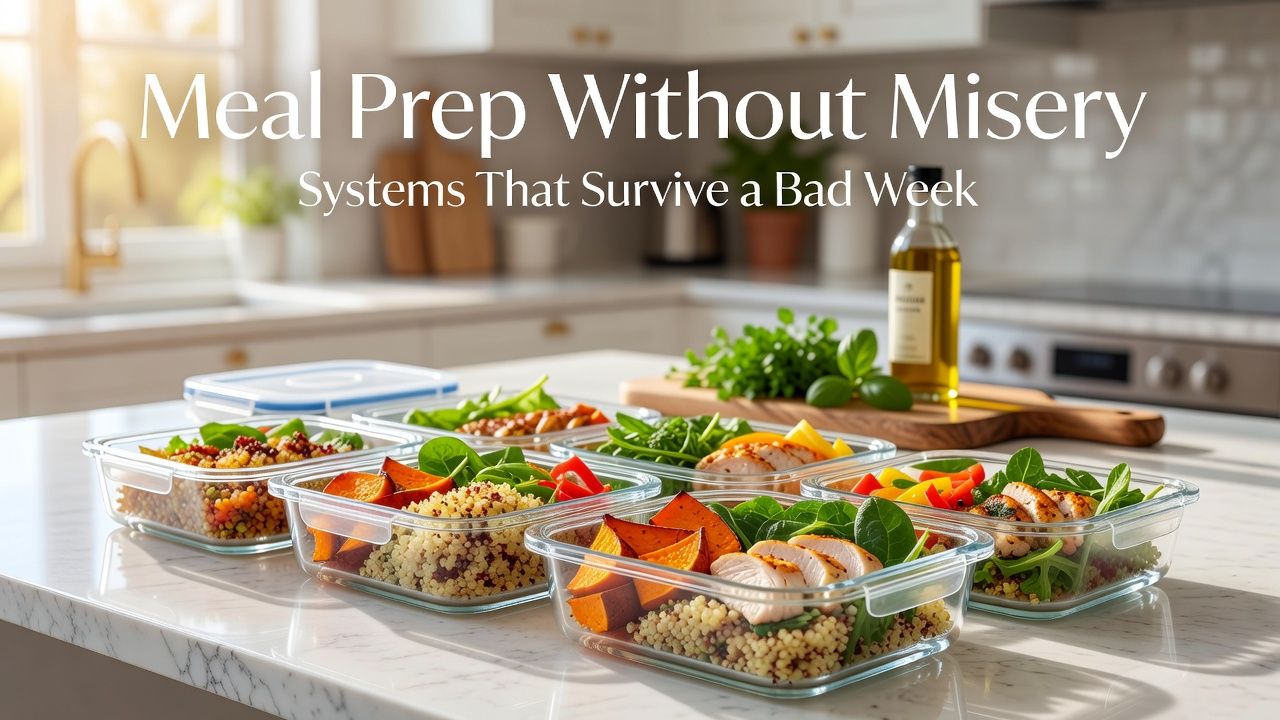
The problem was never cooking. It’s the 6 p.m. decision, made nightly, by a tired brain, with a delivery app in reach. Beat the decision, and the rest mostly takes care of itself.
Sunday, 6:12 p.m. The fridge contains half an onion, condiments, and optimism. You are tired, the week is already leaning on you, and within four minutes the delivery app has been opened and a $34 order of something beige is on its way. If this scene is painfully familiar, know two things. First, you’re in enormous company; the gap between “people who intend to cook” and “people who cook” is one of the widest in household economics. Second, the failure wasn’t willpower, and it wasn’t cooking skill. It was, pure and simple, a system failure: the decision got made at 6 p.m. by the most depleted version of you.
That’s the insight this whole article runs on. Meal prep, done right, is not about cooking more. It’s about moving the decisions to a time when your brain works, so the tired version of you only ever has to execute, never choose. And “done right” means building for the bad week, because the system that only works when you’re rested and motivated is not a system. It’s a hobby with containers.
Why the Instagram Version Fails The twenty-one-container trap
The standard meal-prep image, seven identical boxes of chicken, rice, and broccoli, fails almost everyone who attempts it, and the failure is predictable. First, monotony: by Wednesday, the sight of the chicken produces a small existential crisis, and the delivery app wins anyway. Second, fragility: the full-week prep requires a heroic Sunday, every Sunday, and one missed or chaotic Sunday collapses the whole week. Third, texture: a Thursday portion of Sunday’s chicken is a punishment, not a meal.
The research-adjacent truth about home cooking is that its benefits are dose-dependent but modest per meal: studies consistently link more home-cooked dinners with better diet quality and lower spending, and the MyPlate healthy-eating-on-a-budget resources exist because the money math is real. But “more home cooking” is achieved by ordinary, flexible, forgiving systems, not by perfect ones. The goal is five decent dinners a week, not a refrigerator that looks like a spreadsheet.
Components, Not Meals The core redesign
Here’s the single most important shift: prep ingredients, not finished dishes. Instead of seven identical meals, a good Sunday session produces a set of mix-and-match components: two proteins (a tray of roasted chicken thighs, a pot of beans or lentils), two or three vegetables (a sheet pan of roasted whatever’s cheap, a bag of washed greens, chopped raw crunch), one or two starches (a rice cooker of rice, roasted potatoes, tortillas), and two sauces. Sauces are the soul of the system: the same chicken over rice with peanut sauce on Monday and with salsa and tortillas on Tuesday are, to your brain, different dinners.
Assembly takes four minutes on a weeknight and, crucially, feels like cooking rather than reheating, which is most of the psychological battle. Variety returns, texture survives (roast veg reheat well; assembled bowls are built fresh), and the system tolerates imperfection: run out of one component and the week doesn’t collapse, it just gets simpler. The pros call this mise en place thinking, and restaurants survive on it nightly. Your kitchen can borrow it wholesale.
The Bad-Week Tier Design for the worst case
Every prep system should have an emergency layer that requires nothing: no Sunday session, no fresh ingredients, no energy. This is the freezer and pantry tier, and it should always be stocked. Freezer: frozen vegetables (nutritionally comparable to fresh, often picked riper), frozen proteins, a few portions of whatever you cooked double of last month, and dumplings or their local equivalent, which are a complete dinner from frozen in ten minutes. Pantry: pasta, jarred sauce you actually like, canned beans, canned fish, eggs in the fridge, rice, tortillas, and the spice shelf.
Write the list of your five zero-effort emergency meals now, on paper, inside a cupboard door. Mine-for-an-example: pasta with tuna and frozen peas; eggs on tortillas; beans on toast, upgraded; freezer dumplings with bagged greens; rice, fried egg, hot sauce. The bad week will come. When it does, the cupboard list is what stands between you and five nights of delivery, and it’s the difference between a system and a Sunday hobby.
The Shopping System Where the week is actually won
Prep fails at the store more often than at the stove. Two tools fix it. The standing list: a master list of your staples, proteins, produce, pantry, taped inside a cupboard or kept in your phone, checked rather than composed each week. Composing a list from scratch is a cognitively expensive task you’ll skip; checking a standing list takes ninety seconds. The one-shop week: pick a day, same day weekly, and make it the rhythm; a midweek top-up for fresh greens is allowed, but the multi-shop week is usually a symptom of shopping without the list.
At the store, the budget logic is boring and effective: seasonal and frozen produce, store brands (identical supply chains, frequently), proteins bought by the family pack and split at home, and a hard rule against shopping hungry, which is not folklore, hunger measurably increases purchases of exactly the foods you’re trying to keep out of the house. The meal-prep system’s quiet superpower is that shopping becomes a delivery run for a decision already made. You’re not browsing. You’re executing a plan made by Sunday-you, who was rested and wise.
The Ninety-Minute Sunday The session, step by step
The prep session, optimized for people who don’t want to spend Sunday cooking: Minutes 0–10, setup. Oven to 425°F, rice cooker on, big pot of salted water or a second burner for beans, cutting board out, containers ready. Minutes 10–35, the oven does the work. Chicken thighs on one sheet pan, chopped vegetables tossed in oil and salt on another, both in. You are now free; the oven is cooking your week while you do something else. Minutes 35–60, stovetop. Beans or lentils simmer; a grain finishes; you wash greens and chop one raw vegetable. Minutes 60–90, sauces and packing. Two quick sauces (a jarred-base peanut or yogurt sauce, a vinaigrette, salsa doctored with lime), components into containers, ten minutes of kitchen reset. Ninety minutes, mostly unattended, with a podcast. That’s the whole session.
Two upgrades once the base is running: cook once, eat twice, deliberately doubling a dinner to bank a freezer portion each week, which builds the emergency tier for free; and the fifteen-minute Wednesday refresh, a midweek mini-prep (roast one more pan, boil eggs, refresh the greens) that extends the system’s reach to Friday without a second big session.
Food Safety, Briefly The rules that matter
Prep means eating days-old food, so the basics are non-negotiable, and there are only a few. Refrigerate cooked food within two hours (one in hot weather), in shallow containers so it cools fast; the deep pot of warm rice sitting on the counter for four hours is the classic mistake. Fridge life for cooked proteins and most dishes: three to four days, which is why the Wednesday refresh exists. The freezer is your pause button: anything you won’t eat by day four goes straight in, day one if you know. Reheat to steaming hot throughout. When in doubt, throw it out is wasteful-sounding but correct, and “smells fine” is not a safety test, the dangerous bacteria are not always the smelly ones. Trust the calendar, not the nose.
The Money Math What the system is worth
Run your own numbers once, because they’re motivating: a delivered dinner for two commonly lands at $30 to $45 all-in; the same meal from your prep system costs perhaps $4 to $8. A household replacing four delivery nights a week is looking at a difference measured in thousands per year, which is why meal planning shows up in budget guidance like the CFPB’s money-management tools as a first-order lever, right alongside the big fixed costs. It’s the rare frugal move that’s also a health move and, honestly, often a quality move: your Tuesday bowl beat the beige delivery on taste by Thursday of week one.
And there’s a subtler economic benefit: the system eats the food you buy. American households famously throw away a staggering share of their groceries, and a prep system with a components approach and a freezer tier attacks waste directly, because everything has a next use. The limp vegetables become the roasted pan. The roast pan becomes the freezer portions. The onion half from the opening scene becomes Tuesday. Waste is a planning failure, and this is the plan.
Feeding the Skeptics Kids, partners, and the picky
The component system was practically designed for mixed-preference households, because it deconstructs the meal: same table, same components, different assemblies. Kids eat the plain version (rice, chicken, the one vegetable they’ve accepted), adults take the full bowl with sauces, and nobody cooks twice. The research on kids and food exposure says repeated low-pressure presence of a food is how acceptance grows; the component table produces exactly that, nightly, without a fight. The picky partner gets agency (they assemble), you get a single cooking session, and the delivery app gets a quieter month.
One honest warning: don’t use the new system as a vehicle for a nutrition crusade on day one. The fastest way to kill meal prep in a household is to make every component virtuous and brown. Keep the flavors generous, the sauces unembarrassed, and one component per week that’s pure pleasure. The system survives on anticipation, not penance.
Starting Without the Overhaul The two-week on-ramp
Don’t build the whole machine this weekend; that’s the Instagram failure again. Week one: stock the emergency tier properly (freezer, pantry, the cupboard-door list) and prep exactly one component, a tray of roasted vegetables, which will teach you more than any article. Week two: add the protein and one sauce, and assemble two dinners from the system. Week three and beyond: the full ninety-minute session, if and only if the smaller version already saved you a delivery night or two. Systems earn their complexity one rescued weeknight at a time. Start embarrassingly small, let it prove itself on a normal week, and then let it grow, over a month or two, into the thing that quietly answers “what’s for dinner” before the question ever gets expensive.
The Equipment That Earns Its Space A short, opinionated list
You need less than the internet says. Two sheet pans, because the oven does the heavy lifting and one pan is a bottleneck. One sharp chef’s knife and a big cutting board, the single highest-leverage purchase in home cooking; dull knives make prep miserable and misery is what we’re eliminating. A rice cooker or a pot you’ve mastered. Containers you like, matched, with lids that seal, glass if you’ll reheat in them; buy two sets of the same kind so they stack and nest like they were designed by adults. A freezer that gets used, with a roll of tape and a marker for dating, because mystery freezer bricks get excavated, not eaten. That’s it. No vacuum sealer, no sous vide, no unitasker. The gear serves the system, and the system is ninety minutes and a cupboard list.
Breakfast and Lunch The uncontested wins
Dinner gets the attention, but breakfast and lunch are where prep pays off fastest, because they’re routine meals where repetition doesn’t hurt. Breakfast: pick one prep-able default, overnight oats in four jars, a dozen boiled eggs, yogurt and frozen berries, and the morning decision vanishes entirely. Lunch: the component system’s leftovers, deliberately cooked one portion heavy at dinner, become tomorrow’s lunch automatically, which converts the most expensive daily meal (the $14 desk salad, the sad sandwich run) into a solved problem. Two meals a day, nearly decision-free, before the system even touches dinner. If the Sunday session ever feels like too much, this is the version to keep: breakfast jars plus lunch-portion dinners is a complete meal-prep practice that requires almost nothing and returns the daily 6 p.m. and 12 p.m. panics both.
The Skill Floor Four things that make it taste good
The last reason prep systems die: the food tastes worthy instead of good, and worthiness loses to delivery by Thursday. The fix is four micro-skills, each learnable in one evening. Salt earlier and honestly, food salted during cooking tastes seasoned; food salted at the table tastes salted. Heat properly, crowded pans steam instead of brown, and browning is flavor, so give the vegetables space and the chicken a hot pan. Acid at the end, a squeeze of lemon or a splash of vinegar wakes up anything that tastes flat, which is most day-three meals. One sauce you crave, because the sauce is the difference between “assembly” and “leftovers.” Master those four and the system’s food stops being something you endure for your budget and starts being the thing you actually want, which is the only form in which any of this survives the year.
One final upgrade for the social animals: don’t prep alone. A Sunday session shared with a partner, a housemate, or a friend on speakerphone converts the chore into the week’s best conversation, and some households run prep swaps, each person doubles one dish and trades portions, so everyone’s freezer diversifies without anyone cooking more. Even the cleanup splits better across two people. Meal prep’s reputation is solitary and virtuous; its most durable real-world form is neither. The kitchen system that lasts is usually the one with another person in it, because accountability tastes good and, unlike most wellness habits, this one ends in dinner.
This article is general education, not medical or dietary advice. Sources linked above include USDA MyPlate and the Consumer Financial Protection Bureau. This article contains no affiliate links and no brand recommendations. All outbound links checked live in August 2026.