CBT, ACT, DBT, psychodynamic, EMDR: the alphabet soup is real, but the differences are learnable in one sitting, and knowing them changes what you ask for and what you get.
So you’ve decided to talk to someone. Good. Now comes the part nobody warns you about: “therapy” is not one thing. It’s a family of approaches with different mechanics, different timelines, and different evidence bases, delivered by people with different licenses, at prices ranging from free to eye-watering. Most people respond to this complexity by picking whoever has availability and a friendly photo. Sometimes that works out. But a little orientation goes a long way, because the fit between approach, therapist, and problem shapes outcomes more than most people realize.
Let’s do the orientation properly: what therapy is, what the main schools actually do in the room, what the evidence says, how to choose, and what to do when the first try isn’t working. No jargon without translation, I promise.
What Therapy Actually Is And the two things it isn’t
Strip away the branding and psychotherapy is a structured, confidential relationship with a trained professional, aimed at changing patterns of thinking, feeling, or behaving that are making your life worse. The “structured” part is what separates it from venting to a friend: a good therapist is running a method, even when the conversation feels loose. Sessions typically run 45 to 60 minutes, weekly or so, and the total arc can be six sessions or several years depending on the approach and the problem.
Two things therapy is not. It isn’t paid friendship, because a friend has skin in your life and needs things from you; a therapist’s only stake is your progress, which is exactly why you can say the unsayable. And it isn’t advice-giving, mostly. Good therapists are stingy with advice because your life is yours to run; what they sell is pattern-finding and skill-building. If someone tells you exactly what to do every session, you’re buying a consultant, not therapy. Both the NIMH’s overview of psychotherapies and the APA’s psychotherapy resources are good plain-language starting points if you want the institutional version of this section.
CBT: The Workhorse Cognitive behavioral therapy
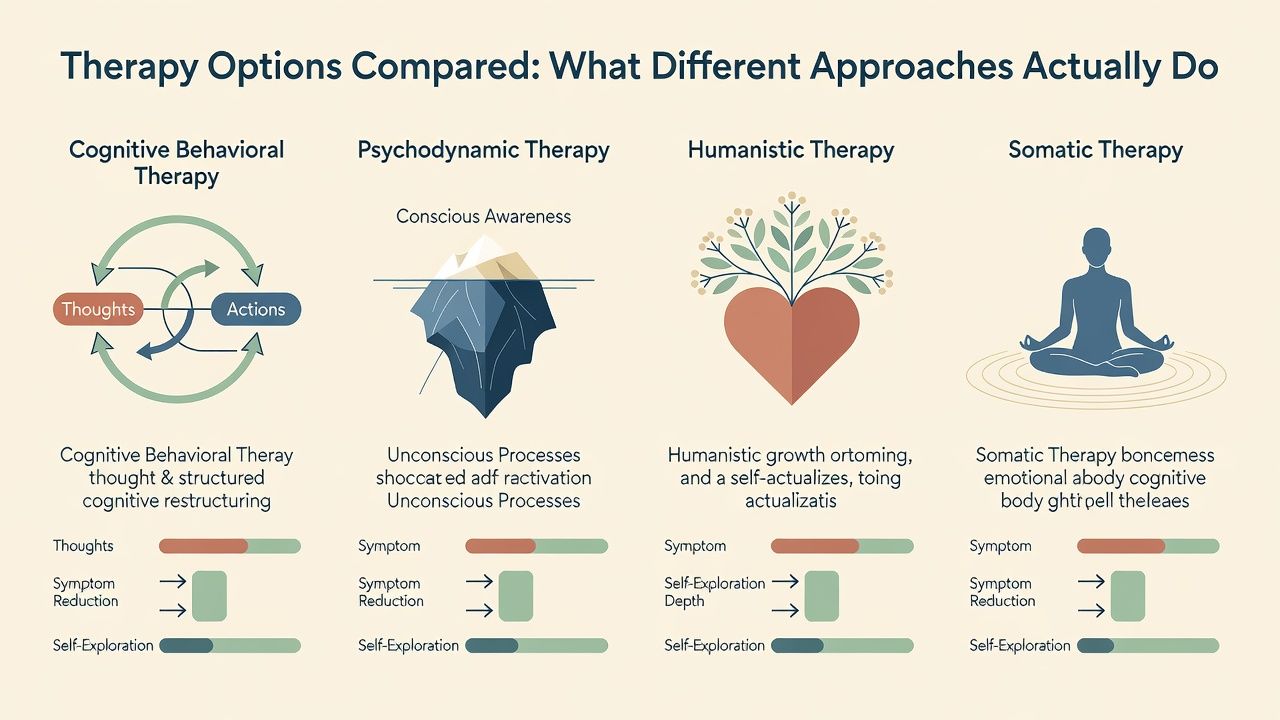
Start with the approach you’re most likely to be offered, because it’s the most researched and the most widely available. Cognitive behavioral therapy rests on a loop: thoughts, feelings, and behaviors feed each other, and changing any one changes the others. In practice, CBT is active and structured. You’ll identify specific distorted thought patterns (“I failed one presentation, so I’m incompetent”), test them against evidence, and practice new behaviors between sessions. Homework is a signature. So is a defined arc: for many anxiety and depression cases, 12 to 20 sessions is a typical course.
The evidence base is the deepest in the field: depression, most anxiety disorders, panic, OCD (with a variant called exposure and response prevention), PTSD, insomnia (CBT-I, the gold-standard non-drug insomnia treatment), and more. The style suits people who want tools, structure, and measurable goals. It suits less well those who want open-ended exploration, and its critics note it can feel surface-level for problems rooted in deep relational patterns. Fair or not, it’s the benchmark every other approach gets compared against.
Psychodynamic Therapy The past in the present
The oldest tradition, descended from Freud but unrecognizably modernized, works from a different premise: much of what drives your current reactions is outside awareness, built from early relationships and old adaptations that once protected you and now constrain you. The work is exploration. Sessions are less structured, the therapist says less, and patterns are discovered in the room itself, including in how you relate to the therapist, which is treated as data rather than awkwardness.
Modern psychodynamic therapy is not the five-days-a-week couch caricature; short-term versions run 12 to 25 sessions with decent evidence for depression and anxiety, and longer-term work suits people whose difficulties are diffuse and repeating: the same relationship ending the same way for the third time, self-sabotage that survives every logical argument. If CBT is a toolbox, psychodynamic work is an excavation. Some people need the tools first. Some keep rebuilding the same wall and need to know why it’s there.
ACT: Acceptance and Commitment Stop fighting the weather
ACT (said as the word, not initials) makes a counterintuitive move: instead of disputing painful thoughts the way CBT does, it teaches you to change your relationship to them. Thoughts are treated as mental events, weather, not commands. The techniques have names like defusion (seeing “I’m having the thought that I’m worthless” rather than being worthless) and acceptance (making room for discomfort instead of organizing your life around avoiding it). Then comes the second half, which gives the approach its name: clarifying your values and committing to actions aligned with them, discomfort included.
The evidence is solid and broad: anxiety, depression, chronic pain, and stress-related conditions all respond, and the chronic-pain application makes intuitive sense once you get the philosophy, when the sensation can’t be eliminated, the suffering layered on top of it still can be. ACT suits people who’ve argued with their thoughts for years and lost, and who find “challenge the distortion” somehow hollow. It’s less about feeling better and more about living better, with the paradoxical result that people often feel better.
DBT: Skills for Big Emotions Dialectical behavior therapy
DBT was built in the 1980s by Marsha Linehan for people with borderline personality disorder and chronic self-harm, a population other therapies were failing, and it worked well enough that its skills have since spread far beyond the original diagnosis. The format is distinctive: individual therapy plus a structured skills-training group, covering four modules (mindfulness, distress tolerance, emotion regulation, interpersonal effectiveness). The “dialectic” is the balance between acceptance and change: you are doing your best, and you need to do differently. Both, at once, held on purpose.
If your core problem is emotional volatility, reactions that go from zero to ninety, relationships that follow a boom-and-crash cycle, coping behaviors that work tonight and cost you tomorrow, DBT’s skills-based approach is the most targeted option on this list. It’s also one of the more demanding: real DBT is a program, often six months to a year, with homework and diary cards. The people it was built for call it life-saving often enough that the phrase isn’t hyperbole.
EMDR and the Trauma Therapies When talking isn’t the mechanism
EMDR (eye movement desensitization and reprocessing) sounds like stagecraft: you recall traumatic material while following bilateral stimulation, classically the therapist’s moving fingers. The strange delivery obscures a serious evidence base; EMDR is recommended by major health bodies for PTSD, with effect sizes comparable to trauma-focused CBT. The leading theory is less mystical than the method: the dual attention (memory plus stimulation) seems to let the brain reprocess stuck memories so they file as past instead of replaying as present. Many patients describe exactly that shift: the memory stays, the charge drains.
Trauma-focused CBT and prolonged exposure therapy sit in the same family: structured, time-limited, built around approaching (carefully, with support) the memories and situations trauma teaches you to avoid. The avoidance feels like safety and functions like a cage; all the trauma therapies are, at heart, supervised ways out of the cage. One caution that matters: for acute trauma, timing and stability come first, and any competent clinician will establish safety and coping skills before opening the vault. If a provider pushes deep trauma processing in session one, find another provider.
The Ones Nobody Brags About Group, couples, and IPT
Group therapy carries an unfair reputation as therapy’s budget option. The research says otherwise: for many conditions it matches individual therapy, and for some problems (social anxiety, grief, addiction support) it has advantages individual work can’t touch, because the group itself is the intervention. Watching someone else articulate your exact shame dissolves it faster than any solo insight. It’s also dramatically cheaper and often has shorter waits. Couples therapy is its own specialty (approaches like emotion-focused therapy and the Gottman method lead the evidence), with one rule everyone ignores: go early. The average couple waits years too long, arriving when contempt has set, which is treatable but harder.
Interpersonal therapy (IPT) deserves a mention as the quiet overachiever: a structured, time-limited approach focused on relationships and role transitions, with strong evidence for depression. If your low mood tracks with a bereavement, a divorce, a move, a new baby, a retirement, IPT was essentially designed for you, and it’s common in clinics even if unknown at dinner parties.
The Cheat Sheet Six approaches side by side
| Approach | What sessions feel like | Strongest evidence for | Typical length |
|---|---|---|---|
| CBT | Structured, goal-focused, homework between sessions | Depression, anxiety disorders, OCD, PTSD, insomnia | 12–20 sessions |
| Psychodynamic | Open-ended exploration; patterns and the past | Depression, anxiety, repeating relational patterns | 12–25 sessions to long-term |
| ACT | Skills for unhooking from thoughts; values-driven action | Anxiety, depression, chronic pain, stress | Varies; often 8–16 sessions |
| DBT | Individual therapy plus structured skills group | Emotion dysregulation, self-harm, BPD | 6–12 months as a program |
| EMDR / trauma-focused | Guided reprocessing of traumatic memory | PTSD, trauma | Often 6–12 sessions |
| Group / IPT / couples | Shared or relationship-focused work | Depression, grief, social anxiety, relationship distress | Usually time-limited |
The Finding That Trumps the Alphabet The alliance effect
Here’s the result that humbles every school: across decades of outcome research, the strongest single predictor of whether therapy helps is not the modality. It’s the quality of the relationship between you and the therapist, what the literature calls the therapeutic alliance. Do you feel understood? Do you agree on what you’re working toward? Do you trust this person enough to say the embarrassing thing? A strong alliance in an imperfectly matched method beats a perfect method with someone you can’t open up to.
Practical consequences: shop, don’t settle. Most therapists offer a brief introductory call, use two or three before committing. Give a decent fit three or four sessions before judging, because early awkwardness is normal. But a persistent sense of being unheard, judged, or pushed somewhere you didn’t agree to go is data, and switching is allowed and common. Therapy is one of the few professional relationships where “it’s not you, it’s the fit” is legitimate, and good therapists will say so themselves.
Access, Cost, and the First Move The logistics that stop people
The gap between deciding to go and actually going is usually logistics, so: the routes. In the US, insurance directories and your insurer’s behavioral health line are the official path, though directories are notoriously stale; professional association finders (the APA’s psychotherapy locator guidance is a reasonable starting point) and referrals from your GP work better. Telehealth is now mainstream and, for most common conditions, performs comparably to in-person care in studies, which matters enormously if you’re rural, busy, or housebound. On cost: sliding-scale clinics, community mental health centers, and university training clinics (supervised graduate students, genuinely good care, low fees) are the underused options. Group therapy, again, is the value play. In the UK and elsewhere, primary care referral opens the public system’s door, with waits as the trade.
The first move, whatever the route, is small: one call or one message to one provider. Momentum beats research. People spend six months comparing therapists and zero months talking to one; reverse that ratio.
Medication, Crises, and the Edges The honest footnotes
Therapy and medication aren’t rivals; for moderate to severe depression and several anxiety conditions, the combination outperforms either alone, while mild cases often do well with therapy first. Most therapists can’t prescribe (psychiatrists and, in some places, specially trained psychologists can; GPs prescribe plenty of mental health medication and are a legitimate front door). And the crisis rule, stated plainly: if you or someone near you is at risk of self-harm, that’s not a wait-for-an-appointment situation. In the US, call or text 988. Elsewhere, local emergency lines or your nearest emergency department. Therapy is for the climbing out; crises are for immediate hands.
Everything else in this article is refinement. The evidence across approaches converges on an unglamorous conclusion: therapy, broadly, works, for most people, most of the time, and the differences between good options are smaller than the difference between starting and not. The NIMH’s self-care pages put professional help in its proper category, not as a last resort but as one of the standard tools. You’d compare gyms before joining one. You’d still be better off just walking through a door.
How to Tell It’s Working And how long to give it
The last gap in most people’s map: what progress actually looks like, because it rarely feels like the movie version. Progress in therapy is usually quiet and behavioral before it’s emotional. You notice you paused before sending the text. You went to the thing you’d have skipped. The spiral still comes but ends sooner, or you can watch it arrive without climbing aboard. Many therapists track this formally with brief questionnaires each session; if yours doesn’t, a monthly one-line note to yourself (“what can I do now that I couldn’t in March?”) does the same job.
On timing: most people report some benefit within the first couple of months, and structured approaches define their full course up front, so by mid-course you and the therapist should be able to say whether it’s helping and adjust if it isn’t. Feeling temporarily worse after hard sessions is normal and often means the work is touching the real material; feeling directionless for months is not the same thing. Therapy should have a shape you can describe: what we’re working on, how we’ll know it’s changing. If you can’t describe it, ask. That question alone has rescued more stalled therapy than any technique on this page.
This article is general education, not medical or psychological advice, and therapy choices belong in conversation with a qualified clinician. If you are in crisis, contact local emergency services or, in the US, call or text 988. Sources linked above include the NIMH and the APA. This article contains no affiliate links. All outbound links checked live in August 2026.