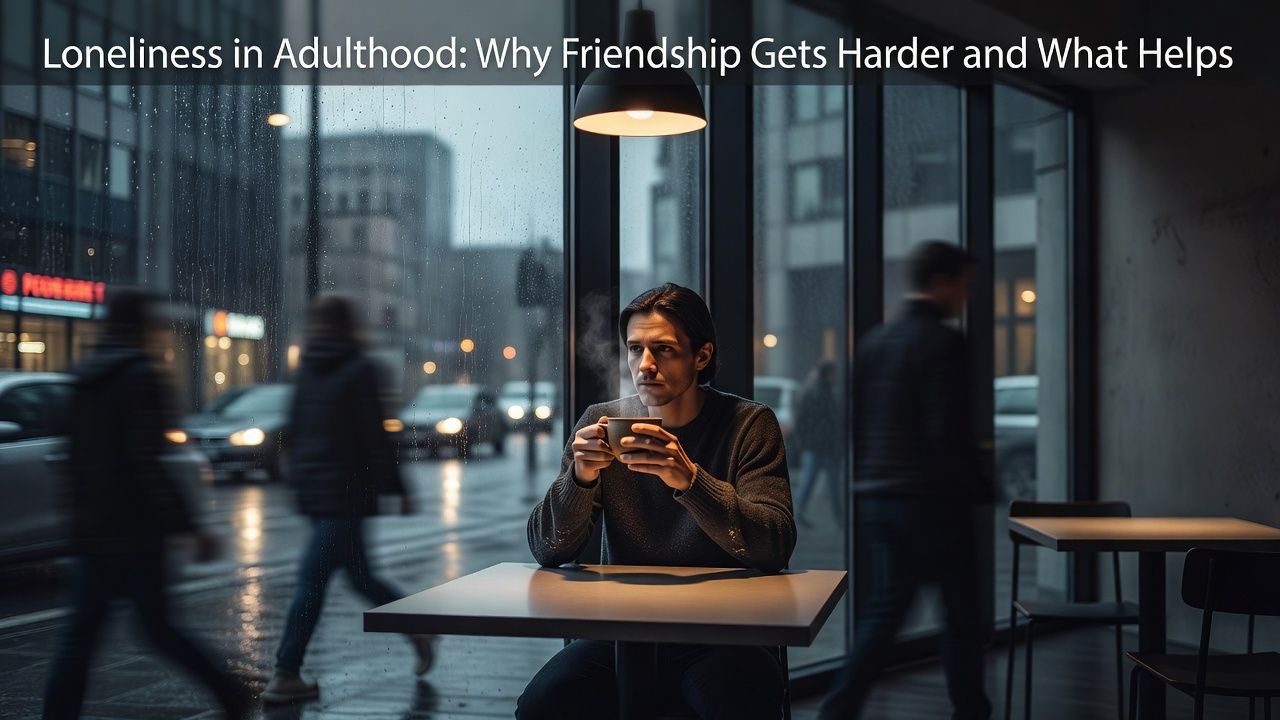
At twenty, friendship happened to you. At forty, it has to be built on purpose, against the schedule, the geography, and a strange shame about needing it. Here’s the honest mechanics.
It usually lands quietly. A Tuesday night, something good or bad happens, and you pick up the phone to share it, and scroll through four hundred contacts and put the phone back down. Not because you know no one. You know hundreds of people. It’s that somewhere between the last group chat that went quiet and the last move for a job, the friendships that would have taken that call evaporated, and you can’t name the day it happened. Nobody can. That’s the thing about adult loneliness: it doesn’t arrive. It accumulates.
If this is you, the first fact worth holding is that you are in enormous, mostly silent company. Loneliness has become common enough that in 2023 the U.S. Surgeon General issued a formal advisory on social connection, calling loneliness and isolation a public health concern on par with the classics, and the HHS social connection page lays out the case: weak social connection is associated with meaningfully higher risk of heart disease, stroke, dementia, depression, and early death. This isn’t a feelings issue with health side effects. It’s closer to a health issue that announces itself as a feeling.
Loneliness Is Not Aloneness The gap definition
Precision first, because the distinction changes the fix. Loneliness is not the state of being alone; it’s the distress caused by a gap between the connection you have and the connection you want. That’s why a person with a spouse, kids, and a packed calendar can be profoundly lonely (the connections exist but don’t nourish), and why a person living solo with two close friends can be entirely fine. Solitude chosen is rest. Solitude imposed, or connection that stays surface-deep, is the deficit.
Researchers also distinguish flavors: emotional loneliness (no one truly knows you), social loneliness (no group you belong to), and the acute situational kind that follows a move, a divorce, a new baby, a diagnosis. Most adults cycle through all three. The practical upshot: “get out more” is useless advice for emotional loneliness, and a deep one-on-one dinner won’t fix the absence of a tribe. You have to name which gap you’re actually trying to close.
Why Adulthood Dismantles Friendship It’s structural, not personal
Here’s the part that should relieve you: the difficulty is engineered, not earned. Childhood and university friendship run on three hidden machines: proximity (you’re physically stuck together), repetition (you meet without planning to), and parallel life stage (everyone’s free at the same times, wanting the same things). Adulthood uninstalls all three. You scatter geographically for jobs and partners. Time gets consumed by work and kids in a zero-sum way that friendship loses by default, because friends don’t have deadlines or custody arrangements. And the calendar math turns savage: scheduling one dinner between two adults with families now requires a negotiation that would impress the UN, which is why it happens quarterly instead of weekly.
Add the cultural layers. Remote work removed the accidental office friendships that carried many adults (love or hate the commute, the colleague-friend pipeline was real). Couple-centric social life quietly demotes single friends and absorbs partnered ones. And there’s a gender skew the research keeps finding: men’s friendship networks in particular thin out across adulthood, often shrinking to a spouse and colleagues, which works until retirement or divorce reveals that both pillars were load-bearing. None of this is anyone’s fault. But systems this hostile don’t yield to good intentions. They yield to counter-design.
The Friendship Formula Time, repetition, disclosure
The research on how friendships actually form is almost disappointingly mechanical, which is great news, because mechanics can be operated. One much-cited study put rough hour-marks on the ladder: around fifty hours of time together moves someone from acquaintance to casual friend, around ninety to real friend, north of two hundred to close friend. The exact numbers matter less than the shape of the finding: friendship is a logged-hours phenomenon. There is no hack. There is only accumulated, repeated, mostly unremarkable time in each other’s presence.
The second ingredient is gradual self-disclosure: friendship deepens when people take turns revealing slightly more than the setting strictly requires, and the other person receives it well. This is why activity-based contact (the same five guys, the same five topics, for a decade) can stay oddly shallow, and why one honest conversation at the right moment can leapfrog years. The formula, then: repeated contact plus escalating realness. Most adult attempts fail on the first factor, not the second. People don’t say the wrong thing; they just never accumulate the hours.
Where Adult Friendships Actually Happen Third places and recurring rooms
Given the hour-marks, the strategy writes itself: you need settings where the same people show up repeatedly without anyone having to schedule it. Sociologists call these third places, not home, not work, and the adult list is shorter than it used to be but not empty: a weekly sports league or running group, a church or community organization, a volunteering shift, a class that meets for eight weeks, a regular game night, the gym at the same hour, a dog park at the same hour, a neighborhood bar or café where you’re a regular. The recurring structure is the whole point. A one-off meetup is a lottery ticket. A Tuesday league is a factory: it manufactures the fifty hours automatically, in the background, while you’re busy doing the thing.
Choose by two criteria. Recurrence (weekly beats monthly, monthly beats “we should do this again”) and side-by-side activity (men especially tend to bond shoulder-to-shoulder over a shared task rather than face-to-face over feelings; build the friendships around the task and let the feelings smuggle themselves in). And then the boring part: go for months. The first six visits you’re the new person. The hours don’t care about your enthusiasm; they just accumulate.
The Skills That Rusted Asking, hosting, following up
Adult friendship also fails on three rusty skills, all retrainable. Asking. Someone has to say “want to grab a coffee after this?” and research on the liking gap shows we systematically underestimate how much people like us and how welcome our invitations are. The ask feels risky; statistically it lands well far more often than it flops, and the flops cost almost nothing. Hosting. Every functioning social circle has one or two people who instigate, the ones who text “Friday, my place, seven.” If your circle lacks one, that’s the vacancy. It requires no charisma, only the willingness to absorb a few non-replies. The host is doing a public service and everyone privately knows it.
Following up. The graveyard of adult friendship is the pleasant one-off coffee that nobody converted. The rule is unglamorous: within a week, propose the next thing. If that feels needy, reframe it: everyone is busy, and the follow-up isn’t pressure, it’s the scheduling system the friendship will run on. Friendships in adulthood don’t drift apart from conflict. They drift apart from logistics, and logistics are solved by whoever is willing to be slightly organized on behalf of both people.
The Cheap, Powerful Move Nobody Uses Reactivating old friends
Before you build new friendships from raw materials, consider the renovation market. Old friends come with the hours pre-logged; the two hundred were accumulated in 2009 and the asset is still there, dormant but real. Research on reconnection consistently finds that people underestimate how pleased an old friend would be to hear from them, by a wide margin. The text you draft and delete, “randomly thought of you, how are things”, is received, on average, as warmly as a small gift. The feared awkwardness mostly doesn’t materialize, because the other person has been having the same Tuesday-night thought about you.
The protocol is simple: three names, one message each, low stakes, no apology essay for the silence (silence is the default adult condition; nobody is keeping score the way you fear). Suggest something concrete and small. Some won’t reply; that’s fine, people are drowning, not rejecting. Some will, and a fifteen-year friendship restarts at a higher tier than any stranger you’ll meet this year. It’s the highest-ROI social move available to an adult, and it takes four minutes.
Weak Ties: The Underrated Layer Why the barista matters
Connection research has a finding that feels too small to matter and isn’t: weak ties, the acquaintances, the gym nod-guy, the neighbor, the regular barista, contribute measurably to wellbeing and belonging, independent of close friendships. A day studded with tiny friendly exchanges registers in your nervous system as social participation, because it is. The lonely adult life is often not friendless so much as transactionally silent: headphones in, deliveries left at the door, self-checkout, remote everything. The friction removed from modern errands was carrying social signal.
You can rebuild a weak-tie layer in a month without a single deep conversation: same coffee place, actual words to the staff, learn two names, chat with the neighbor for ninety seconds, take the headphones out on the walk. None of it becomes friendship, most of it. That’s not the point. It’s the connective tissue that makes a place feel inhabited, and it’s the pool from which, occasionally and unplanned, an actual friend emerges.
Online Community: Partial Credit Use it as a bridge, not an island
The honest verdict on digital community is “yes, but.” Online groups around real shared interests can be genuinely sustaining; for people with rare conditions, niche hobbies, or identities that have no local quorum, the internet provides connection that geography denies, and that connection is real. The research caveat is about substitution: when online interaction displaces in-person contact rather than complementing it, wellbeing tends to suffer. The pattern to aim for is the bridge: online group that becomes a meetup, a Discord that becomes a yearly gathering, a group chat that produces actual dinners. Digital tools are superb at maintaining ties across distance and terrible at replacing the thing itself. Your nervous system was built for rooms, voices, and the occasional terrible shared meal. Give it some.
When Loneliness Is a Symptom The loop that needs help
Sometimes loneliness is the disease and sometimes it’s the symptom, and the difference matters. Depression withdraws you from connection precisely when connection would help; social anxiety makes the medicine taste like the threat; grief rewrites the whole social map overnight. Chronic loneliness also warps perception over time: the lonely brain starts reading neutral social signals as rejection, a hypervigilance that makes new attempts feel doomed before they start. It’s a trap with a lock on the inside.
If you’ve been making the moves for months and the gap isn’t closing, or if the thought of a coffee invite produces dread rather than nerves, that’s the signal to bring in support. The NIMH’s guidance on caring for your mental health covers when self-help stops being sufficient, and a few sessions with a therapist can defuse the specific fears or the low mood that keep the isolation self-sealing. Treating the depression or anxiety often unsticks the friendship machinery without anyone directly addressing friendship at all.
The 90-Day Connection Plan Enough theory
Month one: rebuild the base. Reconnect with two old friends (concrete plan, small ask), fix your weak-tie layer (same café, learn names, headphones off), and pick one recurring weekly activity to trial, chosen for recurrence, not passion. Month two: commit. Same activity, every week, no evaluating until month three; convert one pleasant contact into a second meeting; host one tiny thing, four people, store-bought snacks, low stakes. Month three: assess and deepen. Which recurring room has potential? Who reciprocates? Invest there. And notice what’s changed that isn’t friendship: the texture of your weeks, the number of people who’d notice if you vanished. That number is the real metric, and it moves faster than you’d think.
Adult loneliness feels like a verdict and behaves like a logistics problem. The verdict says something’s wrong with you. The logistics say the machines that made friendship automatic got dismantled, and the rebuild requires a recurring room, some logged hours, one rusty skill at a time, and four minutes to text someone from 2009. The Surgeon General’s advisory frames connection as infrastructure, as essential as it is buildable. Start pouring the concrete this week. It’s allowed to be a little awkward. Everything worth having in adulthood starts slightly awkward, and gets good, reliably, around the seventh Tuesday or so.
The Shame Tax Say it out loud first
One barrier deserves its own paragraph because it quietly funds all the others: the embarrassment of admitting loneliness at forty. Hunger for food carries no stigma; hunger for people somehow does, as if needing friends past thirty were a diagnostic sign rather than the human default. The result is a mutual silence where everyone assumes everyone else’s calendar is full, a room full of lonely people each performing contentment for the others. Breaking it is trivially easy and disproportionately powerful: be the one who says it. “I’ve realized I need more people in my life, and I’m organizing a thing.” You will be stunned by the relief on the other side of that sentence. The admission that feels like exposing a weakness usually functions as an invitation, because it gives everyone else permission to stop performing too. Every thriving adult social circle has an origin story, and the origin story is always one person willing to sound a tiny bit needy for about ten seconds.
This article is general education, not medical or psychological advice; persistent loneliness accompanied by low mood, anxiety, or hopelessness warrants professional support. Sources linked above include the U.S. Department of Health and Human Services and the National Institute of Mental Health. This article contains no affiliate links. All outbound links checked live in August 2026.