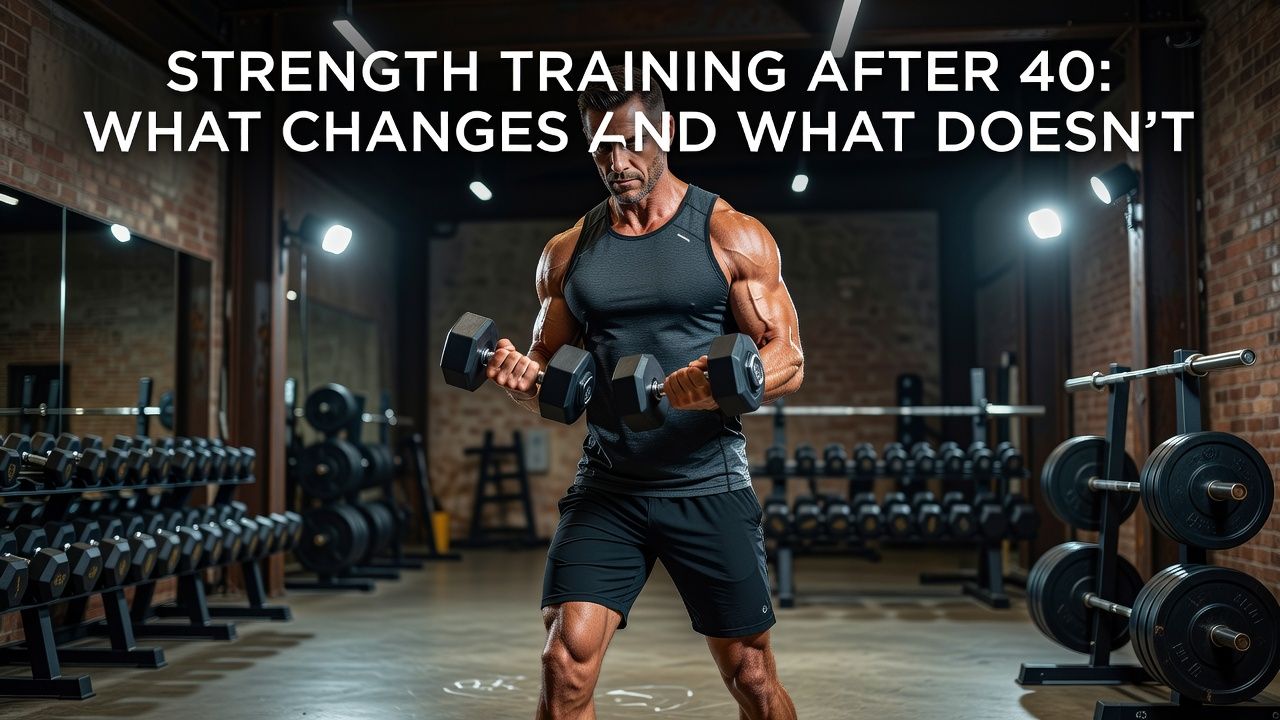
The muscle still responds. The recovery doesn’t forgive. Training well after forty is mostly about knowing which dial aged and which one didn’t.
At some point after forty, the body sends the memo. Maybe it’s the morning stiffness that now has a schedule. Maybe it’s realizing the suitcase feels heavier than the same suitcase felt five years ago. Maybe it’s the first time a doctor uses the phrase “age-related muscle loss” in your presence, as if the muscle had been misplaced. The memo’s content is simple: the maintenance you used to get for free is now optional, and “optional” in physiology means “declining.”
Here’s the counter-memo, and it’s better than you think: muscle responds to training at forty, sixty, and eighty. Studies putting genuinely old adults, people in their seventies, eighties, even nineties, through supervised strength programs routinely find meaningful strength and muscle gains, sometimes dramatic ones. The adaptation machinery still works. What changed is the supporting cast: recovery speed, connective-tissue patience, and the margin for stupid. Train like you’re twenty-five and you’ll learn about all three. Train like an adult with a long-term plan and you can be stronger at fifty-five than you were at thirty-five. That is not motivational copy. It’s a common outcome among people who start.
What Actually Changes The honest ledger
The decline has a name and a schedule. Sarcopenia, age-related muscle loss, begins quietly in the thirties and forties and accelerates past sixty, with commonly cited estimates around one percent of muscle mass per year once it gets going, faster if you’re sedentary, slower if you’re not. Strength falls faster than size, and power (strength applied quickly) falls fastest of all, which matters because power is what catches you when you trip. Bone density follows a parallel decline, especially for women through menopause, when the estrogen that protected bone steps back.
Recovery is the change you’ll actually notice. The hard session you bounced back from overnight at twenty-eight now takes two or three days. Sleep matters more, protein matters more, and the connective tissues, tendons, ligaments, the quiet infrastructure, adapt more slowly than muscle and complain more loudly when rushed. None of this is a reason to lift less seriously. It’s a reason to lift more intelligently. The U.S. Physical Activity Guidelines don’t have an age cap on muscle-strengthening work, they specify it for adults, older adults, and everyone in between, at least two days a week, because the return on investment grows as the decades do.
What Doesn’t Change The encouraging half
Beginners still gain fast. If you’ve never trained seriously, your first year after forty will produce visible, measurable strength increases at a rate intermediate lifters would envy, because the novice effect doesn’t check ID. Progressive overload still runs everything: muscles adapt to slightly more than they’re used to, whether “slightly more” is a heavier dumbbell, another rep, or a harder variation. And the health effects don’t dilute with age, they concentrate. Resistance training in midlife and beyond is associated in study after study with better glucose control, better blood pressure, denser bones, preserved independence, and lower all-cause mortality, with the biggest absolute benefits accruing to the oldest and frailest participants. The WHO’s physical activity fact sheet puts muscle-strengthening work on the global recommendation list for exactly this reason.
Also unchanged: you don’t need a gym personality. Two or three sessions a week, forty minutes each, covering the major movement patterns, delivers most of the benefit. The people who fail at this don’t fail from lack of intensity. They fail from doing twenty-five-year-old programming in a forty-five-year-old body, getting hurt, and quitting. Which brings us to the actual adjustments.
The Adjustments That Matter Five changes, none optional
Warm up like it counts, because now it does. Ten minutes: something to raise temperature, then rehearsal sets of the day’s lifts at light weight. Cold tendons after forty are litigation waiting to happen. Slow the progression. Add load in smaller steps and earn each one; connective tissue lags muscle by weeks, and the gap is where tendonitis lives. Own the form before chasing the number. Technique that was negotiable at twenty-five is load-bearing now. Program recovery deliberately. Forty-eight to seventy-two hours between hard sessions for the same muscle groups, and honest sleep, because the adaptation happens in the recovery, not the workout. Keep the ego in a jar. The fastest way to stop training at forty-two is to insist on out-lifting your memory of twenty-two.
One more adjustment that surprises people: power work matters more now, not less. Because power declines fastest, training it deliberately, controlled, submaximal, but crisp and quick movements, things like kettlebell swings done well, medicine ball throws, or simply standing up from a chair fast and sitting down slow, preserves the quality that keeps you athletic and, later, keeps you upright. Heavy and slow builds the strength; light and quick keeps the spring.
The Minimum Effective Dose What the week actually needs
The evidence-based floor is two full-body strength sessions a week, hitting the big patterns: a squat or leg press (sitting down and standing up, formalized), a hinge (picking things up properly), a push, a pull, and a carry. Two to three sets of five to twelve reps per pattern, with the last couple of reps feeling honestly hard, is a complete program that fits in a lunch break. Machines are fine. Dumbbells are fine. Bodyweight is fine until it stops being hard. The CDC’s activity guidance pairs those two strength days with 150 minutes of moderate aerobic work, and the combination, not either alone, is where the mortality and independence benefits live.
Consistency arithmetic: two sessions a week for a year is roughly a hundred training sessions. That’s enough to be a different physical person. The plan that survives is never the optimal one on paper; it’s the one simple enough to survive February, travel, and a bad week at work. Boring, repeated, slightly progressive. The entire industry exists to distract you from those four words.
Joints, Pain, and the Rules of Engagement Training around the complaints
After forty, most people arrive with a history: a grumbly knee, a shoulder that objects to certain angles, a lower back with opinions. The correct response is almost never avoidance; it’s calibration. Joints generally thrive on load taken through a comfortable range, progressed slowly, and starved by total rest. Work the range that doesn’t hurt, expand it gradually, and use tempo (slow the lowering phase) to make light weights demanding without being provocative. Pain rules that keep you safe: discomfort during a movement that fades when you stop is usually fine to work around; sharp pain, pain that alters your form, or pain that’s worse the next morning means the dose was wrong, not that training is.
Persistent or radiating pain, numbness, or anything that feels wrong rather than hard belongs with a physiotherapist or doctor, and here’s the reframe that matters: a good physio is now part of your training team, the way a mechanic is part of owning an older car. One assessment and a handful of targeted fixes will extend your training life by years. This is maintenance, not defeat.
Protein and the Recovery Budget The boring multiplier
Older muscle is mildly harder to convince. Researchers call it anabolic resistance: the same meal or workout triggers a smaller building response than it did at twenty-five. The practical counter is dull and effective: more protein, spread across the day. Sports-nutrition guidance for older adults typically lands around 1.2 to 1.6 grams per kilogram of body weight daily, higher than the minimum recommendations written for avoiding deficiency rather than building tissue. For a 75-kilo person that’s roughly 90 to 120 grams, which most adults undershoot badly at breakfast and lunch and then chase at dinner. Thirtyish grams per meal is a better shape.
The rest of the recovery budget is the same four items as ever, just less forgiving: sleep (where the growth happens, literally), food that isn’t an afterthought, rest days that are actually restful, and alcohol kept honest, because it taxes both sleep quality and muscle repair. None of this requires a supplement shelf. It requires treating recovery as part of the program instead of the absence of one.
Women, Bone, and the Menopause Window Where the stakes are highest
Everything in this article applies doubly to women over forty, because the physiology raises the stakes. Through the menopause transition, falling estrogen accelerates bone loss, and the classic outcomes, hip fractures, spinal compression, are downstream of decades of quiet deficit. Muscle and bone are the same conversation: bone remodels in response to load, and resistance training is one of the few interventions that meaningfully tells it to keep building. The old fear that heavy lifting is dangerous or “bulking” for women has been refuted so thoroughly that the remaining mystery is its persistence. Heavy-for-you, well-coached lifting after forty is protective; it’s the decades of never loading the skeleton that carry the risk.
The same goes for the pelvic floor and the changes nobody puts on the gym poster: targeted strength work, sometimes with a women’s-health physio, addresses problems that generations of women were told to simply accept. Midlife is not the season to train less. It’s the season the training starts paying compound interest.
The Starter Template Two days, no overwhelm
For someone starting (or restarting) after forty, here is a skeleton that works at home or in any gym, twice a week with at least two days between: goblet squat to a comfortable box or chair, two or three sets of eight to ten. A hip hinge, Romanian deadlift with dumbbells or a good-morning pattern with a band, same sets. A push: dumbbell press or an elevated push-up you can own. A pull: a row, band, dumbbell, or machine. A carry: heavy-ish weights held at your sides, walked thirty meters, shoulders down. Finish with five minutes of the balance and power extras: single-leg stands, sit-to-stands done crisply. Add a little weight or a rep when the current dose stops feeling like work. That sentence, repeated for a year, is the entire method.
Log it. Not for optimization, for continuity. The log is how you know what “a little more” means next week, and on the bad days, flipping back six months is the most motivating document you own. The American College of Sports Medicine has position stands and public resources on progression and older-adult training if you want the formal version; the informal version is above.
When to Buy Help The case for three sessions of coaching
Final note on guidance, because pride kills more programs than laziness. If you’re new to lifting, or returning with joint history, a few sessions with a competent trainer or physio to groove the five patterns is the best money in fitness. Not a year of sessions, just enough to install the movements correctly, because the form you practice is the form you keep. Ask around, look for someone who trains people your age and talks about longevity rather than transformation, and treat it like driving lessons: a short, unglamorous investment that makes the next forty years safer. The body after forty is a fantastic machine with a stricter service schedule. Follow the schedule and it will carry you, powerfully, for decades. That’s the whole deal, and it’s a good one.
What You’re Actually Training For The eighty-year-old test
Motivation needs a better target than the mirror, and gerontology offers one: train for the last decade, not the next beach season. Researchers who study aging talk about backcasting, picturing what you want to be capable of at eighty and working out what strength reserve that requires at fifty, because you’ll spend the intervening decades slowly spending the reserve down. Getting off the floor unaided, carrying your own groceries, climbing stairs while traveling, catching yourself mid-trip: these aren’t fitness goals, they’re independence goals, and they all have a strength price. The cheapest time to pay it is now, when a year of two-day-a-week training can bank a reserve your future self will draw on daily. The gym after forty isn’t vanity. It’s a pension plan with a barbell.
The Metrics That Matter Now New scoreboard
Retire the twenty-five-year-old scoreboard. Nobody’s coming to check your one-rep max, and chasing it is how midlife lifting careers end in month nine. The metrics worth tracking after forty: Can you do more good reps this month than last? Do your joints feel better or worse over the season, not the session? Is your resting blood pressure or glucose moving the right way at checkups? Can you do things in life, the floor, the stairs, the suitcase, with visible margin? And the master metric, the one that predicts everything else: are you still training in December? The strongest sixty-year-olds aren’t the ones who trained hardest at forty-two. They’re the ones who never fully stopped, because they picked a sustainable dose and protected it. Longevity in the habit beats intensity in the workout, every single time.
Expect the timeline, too, so you don’t misread it. Weeks one to three, the gains are mostly coordination, your nervous system learning the movements, which is why loads jump quickly at first. Weeks four to eight, real tissue adaptation begins, and this is also where enthusiasm typically meets tendon patience, so hold the small progressions. Somewhere around month three, people notice the life changes first: stairs, suitcases, getting off the floor, and only afterward the mirror. Month six, the habit is either installed or it’s not. If it is, you’re on the compounding curve now, and the rest of this article becomes maintenance instructions for a machine that’s finally running.
This article is general education, not medical advice; consult a clinician before starting a new exercise program if you have cardiovascular, metabolic, or joint conditions, and see a professional for persistent or radiating pain. Sources linked above include the U.S. Department of Health and Human Services, the WHO, the CDC, and the ACSM. This article contains no affiliate links and no product recommendations. All outbound links checked live in August 2026.