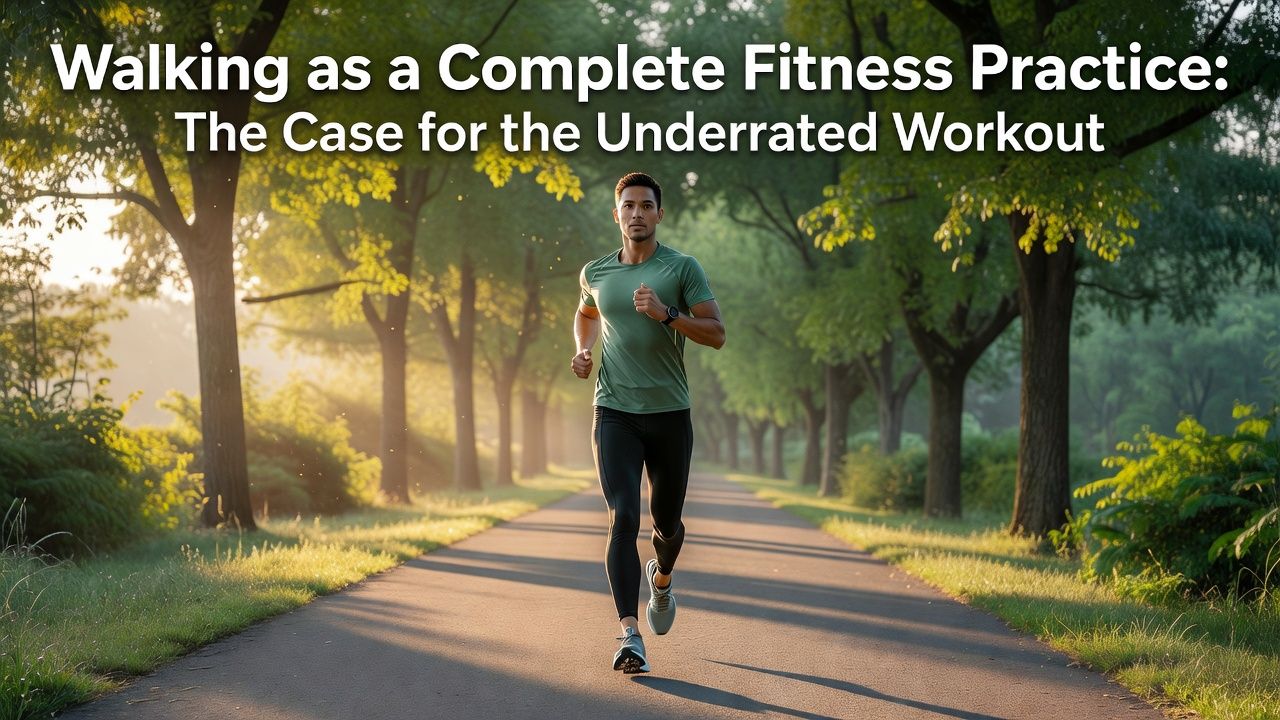
It doesn’t look like exercise, which is exactly why it works. Walking is the only workout with near-universal adherence, near-zero injury rate, and an evidence base most boutique fitness trends would trade their branding budget for.
Nobody brags about their walk. There’s no walking selfie genre, no walking studio with a waiting list and a forty-dollar drop-in. A person heading out the door for forty-five minutes of brisk nothing looks, to the modern fitness imagination, like someone who has given up. Meanwhile, in the actual research literature, that person is quietly collecting some of the most robust health effects science can measure, with a dropout rate close to zero and an injury rate to match.
This is the case for walking taken seriously, as a practice rather than a consolation prize. Not because it’s cute or accessible, but because the combination of evidence, sustainability, and floor-is-lava simplicity makes it, for most sedentary adults, the single highest-value change available. Let’s start with what it actually does.
The Evidence Is Not Modest What the studies actually show
Walking sits inside the aerobic-activity evidence base, which is enormous. The global guidelines converge on the same target: the WHO recommends 150 to 300 minutes of moderate aerobic activity a week, and brisk walking is the reference example of “moderate” in nearly every public-health document ever printed. Hit that target and the associations with reduced risk of cardiovascular disease, type 2 diabetes, depression, dementia, and early death are consistent across decades of cohort studies. The dose-response curve has a crucial shape: the steepest gains come at the start, going from nothing to something. The person who adds a daily half-hour walk captures a large share of the total available benefit. Everything after that is refinement.
The step-count studies made the same point in modern packaging. Pooling across large cohorts, mortality risk drops steadily as daily steps rise from very low levels, with most of the benefit arriving by roughly 7,000 to 8,000 steps and a plateau not far beyond, which is a polite way of saying the famous 10,000 was always marketing, not physiology. The American Heart Association’s walking resources exist because cardiologists got tired of waiting for people to discover this. Fewer than one in four adults meet the basic activity guidelines. The gap isn’t knowledge. It’s that nobody sold the easy version.
The Adherence Advantage The workout you don’t quit
Exercise science has a dirty secret: the best program is worthless if abandoned by March, and most are. Adherence is the multiplier on everything, and walking wins it by design. It requires no gym, no schedule, no skill acquisition, no shower afterward, no recovery day, and no courage. It tolerates interruption (a walk split into three ten-minute chunks retains most of the value, something the guidelines explicitly recognize). It scales infinitely, from a cardiac-rehab patient doing hallway laps to a fit person rucking hills with a weighted pack. And it almost never injures you, which matters more than any other single variable, because injury is how exercise habits die.
There’s a subtler sustainability feature: walking doesn’t trigger the compensation behaviors that eat the benefits of harder exercise. Brutal workouts make people ravenous and sedentary afterward (“I earned this couch”), and studies keep finding the net energy and movement gains smaller than the workout log suggests. Walking flies under that alarm. You don’t feel wrecked, you don’t overeat in penance, and you keep moving the rest of the day. The boring workout is boring precisely because your body registers it as life rather than stress, and that registration is the secret.
What Walking Won’t Do The honest ceiling
Honesty section, because the walking evangelicals skip it. Walking is a mediocre strength stimulus: it will not build much muscle or bone, and past the beginner stage it won’t maintain them either, which is why every guideline pairs aerobic work with two days of resistance training. It also plateaus as cardio: once you’re adapted, the same loop at the same pace maintains rather than builds, and your fitness future depends on progression (pace, hills, duration) rather than repetition. And as a weight-loss tool it’s oversold: the calorie math of a daily walk is real but small, easily erased by a muffin, which is not a reason to skip it but a reason to expect health, not transformation, from the pedometer.
The complete practice, then, is walking as the base plus two short strength sessions a week, a pairing that covers essentially the entire public-health checklist. Walking alone is a superb answer to the wrong question. The question it answers completely is: what’s the largest health improvement available to a sedentary adult for zero money and zero risk? Everything else is assembly.
Dose, Pace, and the Talk Test How to make it count
“Moderate intensity” sounds vague until you learn the field test: at the right pace, you can talk in full sentences but couldn’t sing comfortably. That’s brisk. For most adults it’s roughly three to four miles an hour, a purposeful stride, arms involved, breathing elevated but controlled. Below that pace you’re strolling, which has its own virtues (mood, circulation, thinking) but doesn’t check the moderate-intensity box. Above it you’re jogging, welcome to it.
Progression is the piece casual walkers miss. The body adapts to a stimulus and then maintains, so the dose needs an occasional nudge: a little faster, a little longer, or a hill. A practical weekly shape for the committed: five to six days, thirty to sixty minutes, mostly brisk, with one longer weekend walk (ninety minutes, exploring, this is recreation not training) and one session with intervals or hills to poke the ceiling. The CDC’s activity pages keep the accounting simple: every minute of brisk counts toward the 150, and bouts of any length count. The minute is the currency. Collect them however you like.
The Post-Meal Walk The highest-value ten minutes
If walking has a single highest-leverage application, it’s this: a ten-to-twenty-minute walk after meals, especially dinner. The physiology is clean. After eating, blood glucose rises; contracting leg muscles pull glucose out of the bloodstream without needing much insulin, and studies measuring continuous glucose show markedly flatter post-meal curves when people walk after eating versus sit. Flatter curves mean smaller spikes, smaller crashes, and less of the sleepy, snacky aftermath that follows a big meal at a desk. For anyone with prediabetes or a family history of it, this is close to a prescription-grade intervention hiding in plain sight.
It doubles as habit architecture. “After dinner, I walk around the block” is a cue-linked behavior with a built-in trigger (the meal happens anyway), which is exactly the structure that survives motivation droughts. The Italians have a word for the evening version, the passeggiata, and notably they built an entire culture around it without once calling it cardio. Take the call while you walk. Take the kid. Take nothing. Ten minutes after eating is the cheapest metabolic insurance sold anywhere.
The Mind Walks Too Why thinkers pace
The cognitive effects are the ones walkers become evangelists about. Darwin built a gravel thinking path. Beethoven carried manuscript paper. Kierkegaard wrote that he’d walked himself into his best thoughts. They were onto something measurable: studies comparing creative output during and after walking versus sitting find a reliable bump in divergent thinking, and the effect doesn’t even require scenery (a treadmill facing a wall works, though the wall is less fun). The mechanism appears to be a loosened, diffuse attention state, aroused but unfocused, that lets associations surface. It’s why the solution arrives on the walk back from the problem.
Then there’s the mood data. Regular walking shows up in the exercise-and-depression literature with effect sizes that would make a pharmaceutical company weep with envy, and a walk in green space reliably outperforms the same walk between concrete. None of this requires hiking boots. It requires leaving, regularly, at whatever pace, and letting the combination of rhythm, light, and mild effort do what it’s done for anxious humans since before there were words for anxiety. Rumination spirals have a physical component, they live in stillness, and motion is a way of interrupting the loop from below.
Technique and Gear Deliberately short
This section is short because walking gear should be. Shoes: comfortable, flexible, replaced when worn, full stop. The twelve-hundred-dollar carbon-plated era has nothing to offer a walker; the best walking shoe is the one you’ll actually wear daily. Posture: tall, eyes forward, shoulders unclenched, arms swinging naturally and a bit more purposefully as pace rises. Foot strike: let it be, your feet know walking. Trekking poles are a legitimate upgrade for hills and creaky knees (they spread load to the upper body and add a small calorie bump), and a light backpack with some books in it converts any flat walk into a ruck, the progression of choice for people who hate jogging.
The only gear that matters is whatever removes friction: shoes by the door, a rain jacket you don’t mind using, and a default route you can start on autopilot. Complexity is the enemy of adherence. The person researching optimal insoles in March is losing to the person already out the door in last year’s sneakers.
Building the Architecture Where the minutes come from
Nobody finds an extra hour a day; they reallocate one. The successful daily walker almost never has more time than you. They have better defaults, and the defaults are the whole game. The classic conversions: phone calls become walking meetings (every call that doesn’t need a screen is a candidate). Errands within a mile walk. Transit one stop early, or the far end of the parking lot, permanently. The lunch hour splits in two: eat, then loop. After dinner, the block. None of these feel like “exercise,” which is the point, because things that feel like exercise get negotiated and things that feel like life just happen.
Track it if tracking helps you (the step counter’s real function is honesty, not motivation), but anchor the habit to cues, not numbers. Numbers fluctuate and demoralize; cues fire regardless. And build the social version in where you can, a standing walk with a friend or partner solves two health problems at once, and the connection research suggests the talking may be worth as much as the steps.
The Weather and Dark Problem Winter is where habits go to die
Every walking practice meets its nemesis in November. The answer is decided in advance, not nightly: winter kit laid out (the Scandinavians are right, there’s no bad weather, only bad jackets), a headlamp or reflective band for the dark months, and an indoor fallback route for genuinely hostile days, a mall, a long hallway, stairs, or a treadmill if you have one. The fallback matters less than the rule: the walk happens at its cue regardless, and only the venue negotiates. One missed day is weather. Two is a precedent. Three is a former habit.
The First Month A progression that respects beginners
Starting from sedentary, the mistake is enthusiasm: an ambitious ninety-minute debut, sore shins, and a quiet abandonment. Instead: week one, fifteen to twenty minutes daily at comfortable pace, after one meal, same time. Week two, twenty-five to thirty minutes, briskness creeping in naturally. Week three, thirty to forty minutes with one hill or a fast segment. Week four, you’re at the guideline dose, and the question shifts from “can I do this” to “which two days get strength training.” Beyond that, progress any dial you enjoy: distance, pace, terrain, a weighted pack, or, the sleeper upgrade, a weekend route worth looking forward to, because anticipation is adherence in disguise.
For older adults or anyone returning from illness, the same shape applies with the numbers shrunk: five-minute bouts, hallway laps, build by minutes not miles. The guidelines’ only real rule is “some is better than none, more is better than some,” and the first dose response is so steep that the frailest starters get the biggest returns. If balance is a concern, that’s a reason to start with support, a companion, poles, flat routes, not a reason to wait.
The Long Game What walkers become
Do this for a year and the changes are the quiet kind that sneak up. Your resting heart rate drifts down. The stairs stop registering as an event. Sleep deepens (the sleep articles’ advice about daytime light and movement is, functionally, a walking prescription). Mood floors rise. You start knowing your neighborhood at ground level, the gardens, the dogs, the seasons, which sounds like nothing and is actually the texture of a life being lived at human scale. And the practice keeps deepening: the walk becomes where you think, where you call your mother, where the day’s static discharges.
Fitness culture sells transformation. Walking sells maintenance, accumulation, and durability, which is why it doesn’t sell. But the epidemiologists keep publishing the same finding in different fonts: the people who walk daily, decade after decade, end up in a different health bracket than the people who cycled through heroic programs. The tortoise framing writes itself, so let’s skip it and say it plainly: the underrated workout was never underrated by the people studying outcomes. Only by the people selling effort. You can start after dinner tonight. That’s the whole pitch.
One more data point for the skeptics, because it reframes the whole activity: dog owners, in study after study, get dramatically more daily movement than non-owners, not because they’re more disciplined but because the dog never accepts an excuse. The lesson generalizes without the pet: the walkers who last are the ones whose walk is attached to something that insists, a cue, a companion, a commitment, a route with a view at the end of it. Motivation is weather. Attachment is climate. Build climate.
This article is general education, not medical advice; anyone with cardiovascular symptoms, significant balance problems, or chronic conditions should clear a new activity program with a clinician. Sources linked above include the WHO, the American Heart Association, the CDC, and HHS. This article contains no affiliate links and no product recommendations. All outbound links checked live in August 2026.