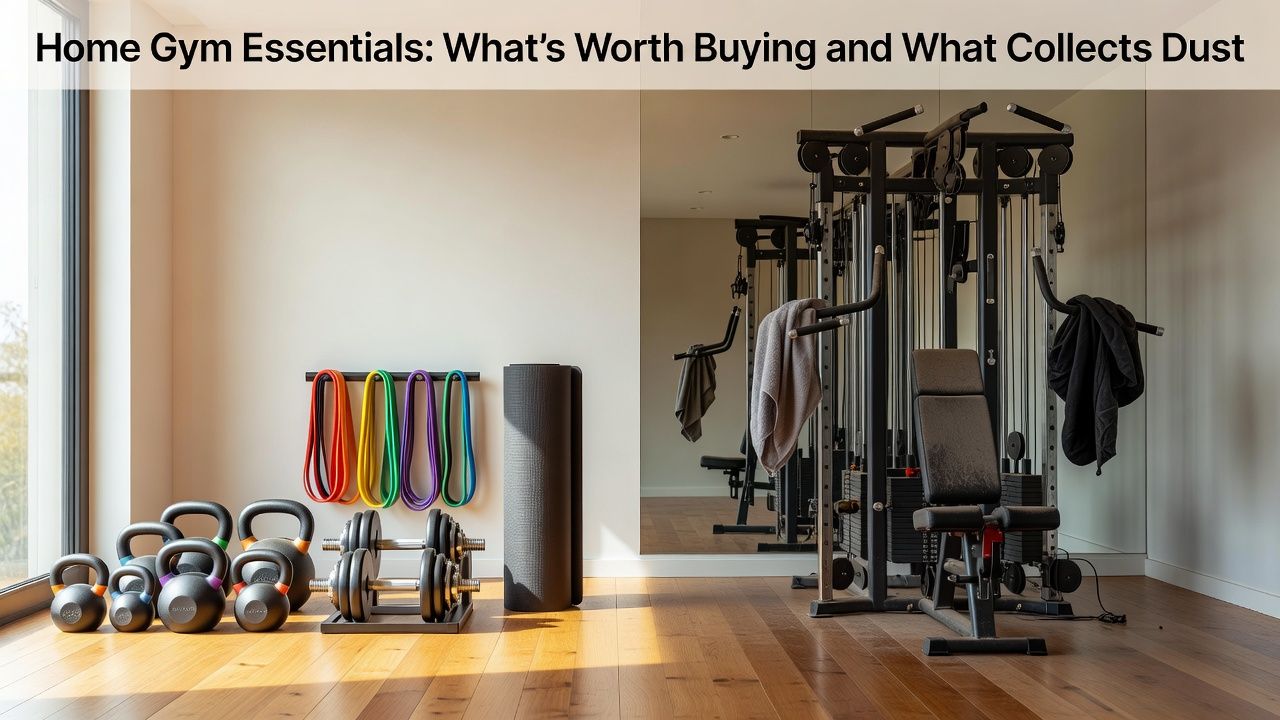
The best home gym is small, boring, and always ready. The worst is a carefully curated monument to a version of you that never showed up. Here’s how to tell the difference before you spend.
Every home gym has a secret museum exhibit. The ab wheel under the bed. The resistance band still in its packaging. The stationary bike that has hung more laundry than it has burned calories. The gap between fitness equipment purchased and fitness equipment used is one of the widest in consumer culture, and it opens because people buy for the workout they imagine instead of the one they actually do.
This article works backward from use. What gets picked up weekly for years? What’s worth its floor space? What should you buy used, what should you skip, and what is the actual minimum that covers the evidence-based checklist, because that’s what a home gym is: a delivery system for the physical activity guidelines, 150 minutes of cardio and two days of strength, minus the commute. Everything else is interior decorating.
The Math First Home versus membership
The financial case is friendlier than people assume. A mid-range gym membership runs roughly $500 to $1,000 a year depending on your market. A complete, durable home setup covering both strength and conditioning can be assembled for the cost of one to two years of membership, and then it stops charging you. The equipment that matters lasts decades, iron doesn’t expire. The counter-argument is real though: the gym sells variety, classes, childcare, and, above all, a place you go. The home gym sells a place you already are. One of those models fails through distance and friction; the other fails through distraction and postponement.
So the honest first question isn’t what to buy. It’s which failure mode is yours. If you’ve sustained a gym habit for six-plus months, keep the membership and maybe add a minimal home kit for gap days. If you’ve quit three gyms, the friction was probably the commute and the clock, and home is the fix. And if you’ve never trained consistently anywhere, start cheaper than you plan, because the habit must be proven before the hardware deserves the investment. Iron outlasts enthusiasm. Buy accordingly.
Tier One: The Actual Essentials Roughly $150–400, covers almost everything
Adjustable dumbbells. The single best home-gym purchase, full stop. One pair replaces a rack of fifteen, stores under a chair, and covers presses, rows, squats, hinges, lunges, and carries, essentially the entire strength checklist. Yes, they’re expensive new. This is the item to hunt used, where they surface constantly at half price from people who bought the museum version. A doorway pull-up bar. Thirty dollars, installs in minutes, and owns the pulling pattern that’s hardest to train without equipment. Can’t do a pull-up? Hangs, negatives, and band-assisted reps are where everyone starts, and the bar doesn’t judge.
A set of resistance bands. Cheap, silent, apartment-proof, and the correct tool for rotator-cuff maintenance, warm-ups, and endless accessory work. They also travel, which converts hotel rooms into gyms. A mat. Not glamorous, but it’s the boundary marker that turns “some floor” into “the gym,” and your knees and downstairs neighbors will both notice. That quartet, dumbbells, bar, bands, mat, covers a genuinely complete strength practice. Everything after it is refinement, comfort, or preference.
Tier Two: High-Value Upgrades Buy when the habit is proven
A flat bench (used, always used, they’re everywhere) unlocks proper pressing, rows, and step-ups, and doubles as the world’s most monogamous piece of equipment. A kettlebell or two earns its space if you’ll actually swing it: swings, goblet squats, and carries are a whole conditioning practice in one cast-iron lump. A jump rope is the best cardio-per-dollar ratio in existence, with the caveat that it’s surprisingly skill-based and brutally honest about your calves. Suspension straps or gymnastic rings hang off the pull-up bar or a door anchor and add rows, push-ups, and core work at scalable difficulty.
The rule for tier two: each item should replace a complaint (“I can’t train X at home”), not create a possibility (“maybe I’d get into Y”). Buy for the program you’re running, not the one you might run. The American Council on Exercise publishes free exercise libraries and workout templates that map cleanly onto this equipment tier, which is the point: the gear list should come from the workout plan, never the reverse.
Tier Three: The Big Commitments Barbells, racks, and cardio machines
A barbell, plates, and a rack are the honest ceiling of home strength training: nothing else loads the big patterns as progressively or as durably, and a basic setup bought used often costs less than a year of a premium gym. The requirements are real though: floor space you’ll protect, a load-bearing floor if you’re upstairs, and, the part people skip, the knowledge to lift without a spotter. Solo barbell work has rules: use safety arms or pins, avoid true max attempts alone, and learn to fail a lift safely before you need to. If those sentences sound like a fun project rather than a chore, you’re ready. If not, the dumbbells were already enough.
Cardio machines deserve the coldest eye of all, because they’re the dust-collection champions. The data of used-market listings tells the story: endless nearly-new treadmills and ellipticals at seventy percent off. Before buying any machine, answer one question with evidence, not hope: do you already do this activity voluntarily? A person who loves rowing will use a rower daily; a person who hates running will not be converted by owning a treadmill. And remember the free competitor: walking outside costs nothing and needs no floor space. The machine’s only real job is beating your weather and your darkness. If it will, and you’ll use it, buy it used, test it hard first, and put it where you’ll see it. If you’re not sure, the answer is the door and a pair of shoes.
The Dust Collectors A taxonomy of regret
Some patterns repeat so reliably in the used listings that they deserve naming. Single-function gadgets: anything that trains one muscle or one movement, ab rockers, thigh things, the whole infomercial genus, loses to the versatile basics every time, because versatility is what survives program changes. Vibration platforms and passive devices: the marketing implies exercise without effort, which is precisely the tell. All-in-one machines bought by beginners: they promise variety, deliver mediocrity across seventeen stations, and consume a room. The cheap version of the right thing: a wobbly bench or failing adjustable dumbbell doesn’t just annoy you, it taxes the habit itself, because sessions spent fighting equipment are sessions closer to quitting. Buy once or buy used quality; don’t buy flimsy.
And the subtlest collector: equipment bought to solve a motivation problem. No purchase manufactures a habit, and the dopamine of assembling the gym often substitutes for the workout it’s meant to host. If the shopping is the fun part, notice that. The barbell doesn’t care how it made you feel to buy it.
The Used-Market Playbook Where the smart money goes
Home gym equipment has one of the best secondary markets in consumer goods, because the sellers are motivated (moving day doesn’t care about your New Year’s resolutions) and the product barely degrades. Cast iron is functionally immortal. The playbook: search consistently rather than urgently, prioritize adjustable dumbbells, benches, racks, and iron plates, inspect moving parts and welds, and negotiate, because the listed price includes an assumption that someone will. Avoid used items where wear matters: treadmills with unknown mileage, anything electronic out of warranty, and bands showing cracks. A reasonable target is fifty to sixty percent of retail for iron, less for machines. The person who sells you their dusty treadmill at a discount is not a cautionary tale. They’re a supplier. Just make sure your plan doesn’t end the same way.
Designing for Adherence The room is the program
Home gyms fail on friction the way gyms fail on distance, so engineer the space like a behavior designer. Visibility first: equipment you can see gets used; equipment in a closet is archival. Readiness second: the dumbbells live loaded and reachable, the mat stays rolled out, the pull-up bar never comes down, setup time is the silent killer of twenty-minute workouts. Scheduling third: the home gym’s fatal ambiguity, “I’ll do it sometime today,” is solved by the same cue-linking as any habit, after coffee, before the shower, at 5:30, non-negotiable as an appointment. And a rule that saves marriages and deposits: define the footprint before buying, because the squat rack that annexes the living room will eventually be evicted by the household, and the evicted rack becomes a listing.
Small spaces change the tactics, not the principles. Apartment-friendly is band-based and dumbbell-based, quiet, and vertical: the pull-up bar, a folding bench, a mat that hangs on a hook. People have built impressive strength in studio apartments for decades. The American College of Sports Medicine’s public resources cover the training principles that make minimal equipment sufficient; progressive overload works with a dumbbell as surely as with a machine. Constraints are fine. Randomness is what kills programs.
Safety Without a Spotter The solo lifter’s rules
Training alone at home quietly changes the risk profile, and a few rules cover nearly all of it. Learn the escape routes before loading up: how to dump a bar off a failed squat onto the safety arms, how to roll a failed bench press down your body or tip the plates off, how to bail from under a dumbbell press (just put them down, it’s the whole advantage of dumbbells). Keep a phone within reach during heavy sessions, which feels paranoid until the day it doesn’t. Mind the floor and the neighbors: bumper plates or mats if you’re above someone, and no dropped deadlifts at 6 a.m. unless you enjoy conflict. And program honestly: solo training rewards leaving a rep or two in the tank. The garage PR attempted alone at 9 p.m. is how people learn physics the hard way.
The Budget Builds Three complete setups
| Budget | What it buys | What it covers |
|---|---|---|
| ~$100 | Pull-up bar, band set, mat | Full-body strength (calisthenics + bands), mobility; cardio = walking |
| ~$350 | Add used adjustable dumbbells and a used flat bench | The complete strength checklist; serious progressive overload |
| ~$900 | Add a used barbell, plates, and a basic rack with safety arms | Everything, indefinitely; the last gym you ever buy |
Notice what’s absent from every tier: machines, subscriptions, and anything with a screen. If you later want a smart rower or an app-connected mirror because you’ve proven you’ll use the underlying activity, wonderful, buy it as a reward for the habit, not a bet on it. The builds above assume the opposite philosophy: start with the smallest setup that covers the guidelines, prove ninety days of use, and let each upgrade be earned by mileage. The home gyms still in use at year five were almost all built that way, one justified piece at a time.
Closing the Loop The inventory test
Here’s the test to run before any purchase, now and forever: “Which weekly session in my current program needs this, and what have I been doing instead?” A real answer means buy it (used). A vague answer means wait. The home gym is not a collection; it’s a machine with few moving parts, and every component should have a job it does weekly. Built that way, twenty square feet and a few hundred dollars will out-train a garage full of good intentions, and the only thing that ever collects dust is the guilt.
The Bodyweight Question Can you skip buying entirely?
Mostly yes, for longer than the equipment industry wants you to believe. Push-up progressions, squats, lunges, hinges (single-leg deadlift patterns), planks, and the pull-up bar’s family cover every major pattern with zero footprint, and the difficulty ladder is real: elevate feet, slow the tempo, add pauses, go single-limb, and bodyweight work stays hard for years. Its genuine limits are pulling (hence the thirty-dollar bar, the one exception worth making) and heavy leg loading, where most people eventually want external weight. So the purist’s answer is: bodyweight plus a pull-up bar is a legitimate long-term practice, especially for the maintenance-minded; add the dumbbells when progression stalls or when loaded carries and goblet squats start sounding appealing rather than extreme. The order matters. Earn the purchase with the program, and you’ll know exactly what the purchase is for.
The Piece Nobody Sells A program
The graveyard equipment all shares one origin story: it arrived before the plan. Equipment is inert; a program is what converts iron into adaptation, and it costs nothing. Write down your week: which two days are strength, which sessions cover which patterns, what “a little more” means when the current dose gets easy. Free, credible templates from the organizations linked in this article beat any impulse buy, and a four-line plan on an index card taped to the wall has produced more fitness than most four-figure machines. Buy the program first, metaphorically, then buy exactly the hardware that program requires. It’s the same inventory test, run once, at the start, before the museum gets its first exhibit.
A last word on the unglamorous end of ownership: maintain the thing. Wipe the bench, check the pull-up bar’s mounts monthly, keep the bands out of sunlight, and re-balance the dumbbells’ plates when they rattle. Ten minutes a month keeps the equipment invisible, which is its highest state: gear you never think about is gear you’re actually using, and the home gym that works is, in the end, the one that asks nothing of you except the workout.
This article is general education, not medical advice; consult a clinician before starting a new exercise program if you have cardiovascular, metabolic, or joint conditions, and learn safe solo-lifting practices before loading barbell work at home. Sources linked above include HHS, ACE, and the ACSM. This article contains no affiliate links and no product or brand recommendations. All outbound links checked live in August 2026.