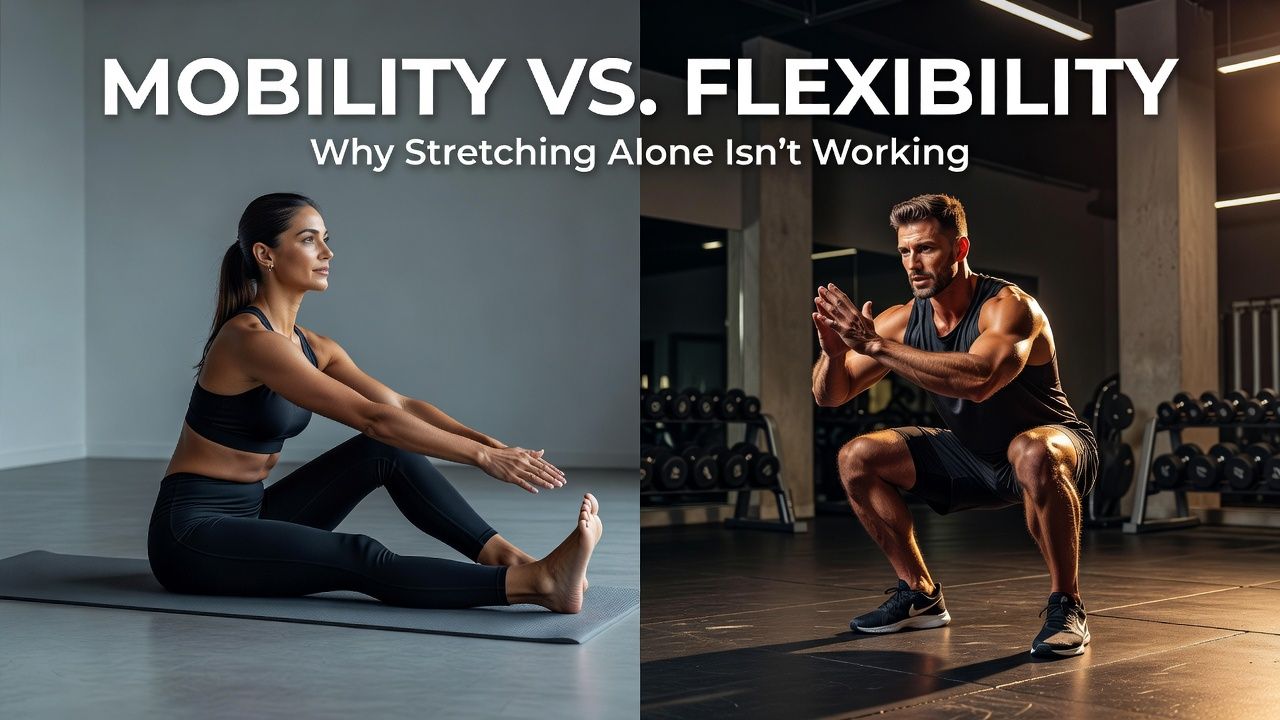
You’ve stretched your hamstrings for years and they’re still “tight.” That’s not a failure of effort. It’s a failure of category, and fixing the category fixes the problem.
Somewhere there’s a person, maybe it’s you, who has stretched their hamstrings after every workout since 2009 and cannot touch their toes any better than in 2009. They’ve held the stretches longer. They’ve bought the strap. They’ve tried the yoga class, twice. The hamstrings remain, in their words, “impossibly tight,” and the conclusion they’ve quietly reached is that their body is just built stiff. Almost everything about that story is wrong, and the correction starts with two words most people use interchangeably: flexibility and mobility.
They are not the same thing, and the difference isn’t semantic trivia. It’s the reason the stretching isn’t working, the reason your squat bottoms out like a folding chair, and the reason your shoulder complains about the top shelf despite years of “flexibility work.” Get the distinction right and a fifteen-minute daily practice actually changes things. Get it wrong and you can stretch faithfully into your nineties and still move like a rusted gate.
The Definitions, Done Properly Passive versus usable
Flexibility is passive range of motion: how far a joint can be moved by an outside force. Lie on your back and have someone lift your straight leg toward the ceiling; the angle it reaches before the hamstring says no is your flexibility. It measures tissue extensibility, mostly, how far the muscle and its wrappings can be lengthened while you do nothing.
Mobility is active, controlled, usable range: how far you can move that joint yourself, under your own muscle power, with control, and ideally under load. Same leg, no helper: lift it yourself. For most people the active number is dramatically smaller than the passive one, and that gap, the difference between the range you have and the range you can use, is the whole story. Flexibility is owning a ladder. Mobility is being able to climb it. Life, and every injury worth preventing, happens on the climbing side.
Why Stretching Alone Fails Three mechanical reasons
First: your nervous system, not your muscle length, is usually the limiter. The sensation of “tightness” is frequently your brain applying a brake because it doesn’t trust that range, you have no strength or control there, so the range gets flagged as unsafe and guarded. Passively stretching a guarded muscle is like tugging on a door held shut by a person on the other side: you can lean on it daily and the door’s position won’t change, because length was never the issue. Second: static stretching produces mostly temporary changes. Acute flexibility bumps fade within hours to days unless something teaches the nervous system the new range is usable. Third: passive work adds no strength at the ends of your range, and end-range weakness is exactly where strains happen, the pulled hamstring at full sprint, the shoulder tweaky at full reach. You stretched the tissue and left it defenseless out there.
This doesn’t make stretching useless. It makes it incomplete. Static stretching reliably improves passive range over weeks, the research is clear on that much, and if your only goal is a slightly longer hamstring, it works. But if your goal is to move well, reach things, squat, play, and not get hurt doing it, passive range without control is a nicer-looking version of the same problem. The American Council on Exercise and similar bodies have spent years nudging the public toward exactly this framing: range of motion is a quality you train, not a rubber band you stretch.
What Mobility Training Actually Is Strength at the edges
Mobility work is strength training at long muscle lengths. That’s the one-sentence version, and everything practical follows from it. The core techniques, translated from the jargon: Loaded stretching, taking a muscle to a lengthened position under light load (a deep goblet squat with a pause, a Romanian deadlift with full range), so the tissue gets longer and stronger simultaneously. End-range isometrics, pushing gently against your limit (pressing your lifted leg down into your own hands), which teaches the nervous system the range is owned, not borrowed. Controlled rotations, slow, deliberate circles through a joint’s full available range, which function as both assessment and training, a daily systems check with benefits.
The results differ from stretching in the way that matters: changes stick, because they’re backed by strength and nervous-system permission. Timelines stay honest, meaningful change runs in weeks-to-months, not sessions, but unlike the stretching treadmill, the progress accumulates. Five minutes of controlled work beats twenty minutes of passive holding, and the ACSM’s training resources consistently place flexibility within complete programs rather than as a standalone fix, which is the institutional way of saying the same thing.
The Big Four Joints Where the audits fail
Hips. The chair-bound generation’s weakest link: flexion for squatting and stairs, internal rotation for everything athletic, extension for walking without shuffling. The tell: you sit with a rounded low back because your hips ran out of motion and borrowed some from your spine. Shoulders. Built for enormous range, maintained for none; overhead reach deficits show up as arching your back to get your arms up. Ankles. The unsung joint: limited dorsiflexion (knee traveling over toes) gets compensated by collapsed arches and cranky knees, and nobody suspects the ankle because it never complains, it just delegates the complaint. Spine. Wants rotation and extension, gets neither; a stiff upper back outsources its jobs to the neck and lower back, both of which file grievances.
Notice the pattern: every stiff joint’s problem is eventually paid by a neighbor. Mobility work is partly debt prevention, keeping each joint capable of its own job so the bill stops arriving at the address downstream.
Self-Assessment in Four Minutes Find your actual deficits
Generic routines waste months on joints that are fine. Spend four minutes finding yours instead. The deep-squat hold: feet shoulder-width, squat as deep as you can without your heels lifting or your chest collapsing onto your knees. Heels rising points at ankles; an early, hard stop with a rounded back points at hips. The overhead test: stand with your back and head against a wall, raise both arms overhead, and try to touch the wall with your thumbs without arching your back. Can’t? Shoulders (or upper back) are borrowing. The knee-to-wall: facing a wall, foot a few inches out, drive your knee forward to touch it without the heel lifting. Less than a few inches of travel is a working ankle deficit. The seated rotation: sit tall, cross your arms, rotate left and right. Asymmetry or pinch is your thoracic spine asking for attention.
Re-test monthly. The assessment is also the motivation, because nothing sustains a mobility habit like watching your own numbers move. Whatever you failed is where your daily minutes go; the joints you passed need maintenance, not investment.
Where Stretching Still Fits A fair hearing for the old way
Having spent three sections correcting the stretching faith, the fair corrections to the correction: static stretching works for what it is. If you want more passive range (and some activities genuinely need it), regular static stretching delivers it over weeks; the research on that is solid. It also downshifts the nervous system beautifully, which is why an evening stretch routine is a legitimate sleep aid even if it never changes your squat. And for some bodies the passive-first route is the safe entry point, post-surgery, acute pain, significant age-related stiffness, where loading end ranges needs professional guidance before enthusiasm.
The correct mental model isn’t “stretching bad, mobility good.” It’s a toolbox with two tools that answer different questions. Flexibility answers “how far can this tissue go?” Mobility answers “what can I do there?” Train the first for range, the second for use, and understand that the second is the one daily life bills you for. The national activity guidelines explicitly add balance and multifaceted movement for older adults alongside the cardio and strength targets; range you can control is the same idea aimed at the joints.
Timing: Warm-Up, Workout, Wind-Down The sequence that actually works
The placement matters more than the menu. Before training: dynamic and controlled work, leg swings, arm circles, controlled rotations, rehearsal reps of the day’s movements at easy ranges. The goal is permission and rehearsal, not length, and this is also why long static holds before lifting are the one genuinely outdated habit: they temporarily reduce force output without buying you anything you needed pre-workout. During training: the sneaky-best mobility work is just strength through full, controlled range, deep squats, full-range presses, hinges with a stretch. Your workout is mobility training if you let it be. After, or in the evening: static stretching’s home, where its nervous-system downshift is a feature and its temporary nature doesn’t matter.
Daily, standalone: five to fifteen minutes of controlled joint rotations and your two personal deficits. That’s the maintenance dose, and it compounds like interest precisely because it’s small enough to do on your worst day.
Age Changes the Stakes Use it, or start losing it
Range of motion declines with disuse at any age, but the curve steepens with decades, and the consequences change category: at thirty, stiff hips cost you a squat; at seventy-five, they can cost you a stair, a curb, a fall. The fall-prevention literature is unambiguous that strength, balance, and usable range are the modifiable trio, and all three respond to training at essentially any age, which is the good news inside the bad news. The goalposts move too: the mobility benchmark that matters in later life isn’t a pigeon pose, it’s getting off the floor, stepping over the bathtub edge, turning to back the car out.
Starting late is still starting. Older adults in mobility and balance programs show measurable gains in weeks, and the daily controlled-rotation habit is almost comically well suited to older bodies: it’s slow, it’s self-limiting, it’s done standing by a counter if needed, and it doubles as the morning systems check that catches a new problem early. The joints don’t need to be young. They need to be visited.
The 15-Minute Daily Practice Putting it in order
Here’s the template that covers the whole article: Minutes 1–5, the sweep. Slow controlled circles, neck half-circles, shoulder circles, arm swings, trunk rotations, hip circles, knee circles, ankle circles, five to ten reps each direction, exploring the day’s available range without forcing. This alone is a diagnostic and a warm-up. Minutes 6–11, your two deficits. Whatever the self-assessment flagged: ankle knee-to-wall rocks with pauses, a deep goblet-squat hold with gentle weight, wall slides for shoulders, couch stretch for hip extension, each with 30- to 60-second efforts and a few end-range pushes against your own resistance. Minutes 12–15, integration. Move through the new range slowly and under control: deep squats rising and lowering, arms sweeping overhead with a straight spine, a slow floor-to-stand if you can.
Fifteen minutes, daily or near-daily, retested monthly. It is not exciting. Neither is flossing, and the payoff structure is identical: invisible for weeks, then one day you squat to the bottom and stay there, or reach the top shelf and notice the shoulder simply went, and you realize the rusted gate has been opening for a while. That’s mobility. Not longer muscles, usable ones. Train the use.
The Desk-Sitter’s Specific Deficits The chair is a mold
If you work at a desk, your deficits are predictable enough to skip the guesswork. Eight to ten hours of sitting holds your hips in flexion (the flexors adapt by shortening), rounds your upper back over the keyboard, parks your shoulders forward, and turns your ankles into passengers. The body remodels toward its most-held position; the chair is a mold and you are being cast. The counter-practice is correspondingly specific: hip extension work (the couch stretch is the desk worker’s national anthem), thoracic extension over a chair back or rolled towel, wall slides for the shoulders, and standing breaks that actually involve movement rather than a walk to a different chair. Frequency beats duration here: five two-minute movement breaks out-mobilize one heroic evening session, because you’re fighting a position held for hours with an argument measured in minutes. Make the argument often.
Myths That Keep People Stiff A quick purge
“No pain, no gain” stretching. Painful stretching triggers exactly the guarding response you’re trying to retire; the productive sensation is strong tension, never pain, and the nervous system grants range to the gentle and persistent, not the heroic. Bouncing. Ballistic stretching has narrow athletic uses and no business in adult stiffness management; slow beats bouncy. Cracking your neck and back. Self-manipulation gives temporary relief because it briefly resets the guard, not because it fixes anything; if a joint needs daily cracking to feel right, the answer is strength and range around it, or a professional’s eye, not louder cracking. “Some people are just inflexible.” Genetics set the ceiling, but almost nobody alive is near theirs; years of sitting set the current address, and the address changes. The evidence on this is cheerfully unanimous: sedentary adults of every age improve range within weeks of starting controlled practice. The stubbornness was never in your hamstrings. It was in the method.
And a closing note on expectations, because impatience is the true stiffness epidemic. Range builds like callus, not like software: a few degrees a month, earned quietly, kept easily once owned. Measure monthly, not daily, and let the practice be small enough to survive your worst week. The people with impressive mobility at sixty are simply the people who never stopped visiting their joints.
This article is general education, not medical advice; joint pain, post-surgical stiffness, or neurological symptoms warrant a physiotherapist or clinician before any range-of-motion program. Sources linked above include the American Council on Exercise, the American College of Sports Medicine, and the U.S. Department of Health and Human Services. This article contains no affiliate links and no product recommendations. All outbound links checked live in August 2026.