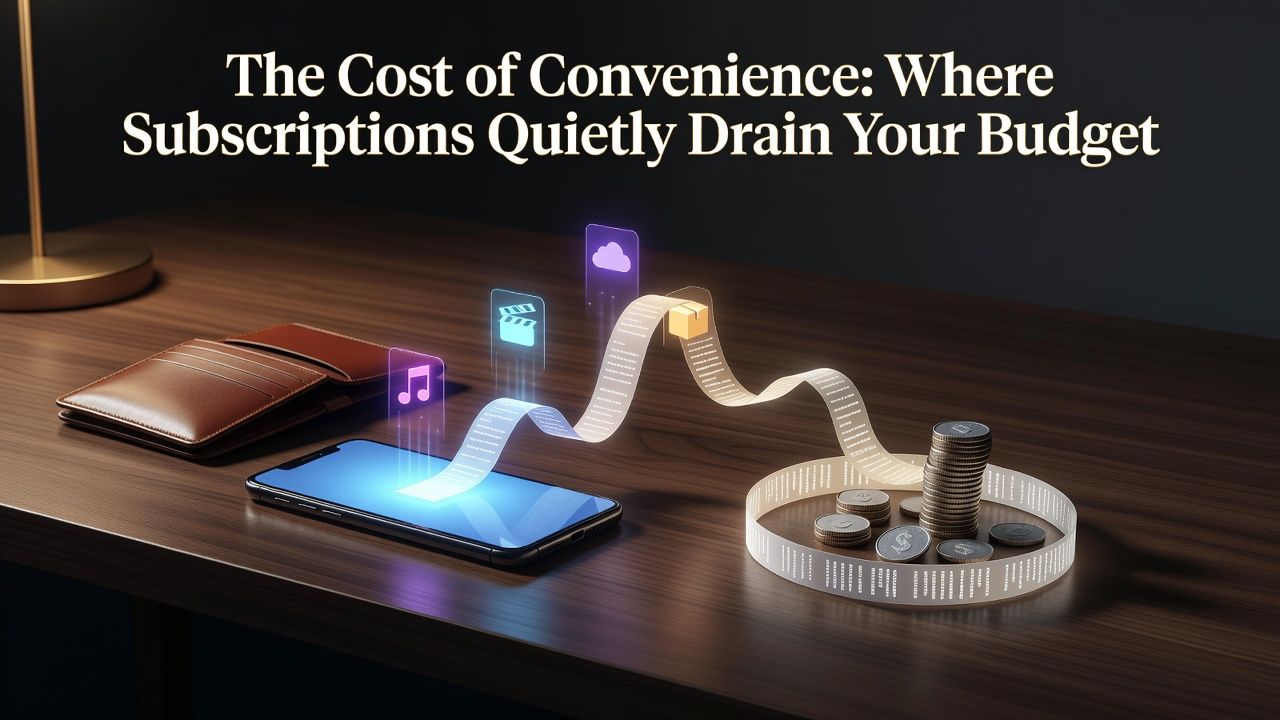
Nobody spends $800 a month on subscriptions. Everybody just spends $12.99, $9.99, $4.99, and $17.99, forever, on things they opened twice. The audit takes one hour. Here’s how to run it.
There is a moment, familiar to millions, when a bank statement reveals a charge you don’t recognize, and after ninety seconds of squinting you realize it’s your own doing: an app you downloaded in 2023, opened twice, and have been funding ever since at $9.99 a month. That’s $360 so far, for nothing, and the sting isn’t really the money. It’s the realization that if this one slipped through, others probably did too. They’re usually right.
Welcome to the subscription economy’s business model, which you are funding. The shift happened gradually and then everywhere: software you used to buy once, music you used to own, razors, meal kits, pet food, car features, heated seats as a monthly line item. Individually each is small and many are worth it. Collectively they’re a silent budget line that surveys consistently find people underestimating by a factor of two or three. The fix isn’t austerity. It’s an audit, one focused hour, plus a few rules that stop the re-creep. This is the playbook.
Why Your Brain Underestimates the Total The psychology doing the draining
Subscriptions are engineered to be invisible, and the engineering is good. Small numbers slip under the mental threshold where spending triggers scrutiny; $12.99 doesn’t feel like a decision, so it never becomes one. Autopay removes the monthly moment of choice that used to force a reconsideration. Free trials convert inattention into revenue, you intended to cancel, the company counted on it. And cancellation is friction-engineered: join in one tap, cancel through a phone call, a retention maze, or a dark-pattern menu, because every extra step sheds a percentage of would-be cancellers. Regulators have noticed; rules around easy cancellation have been tightening, and the Consumer Financial Protection Bureau and the FTC both publish guidance on recurring charges and your rights around them.
There’s one more psychological trick, subtler than the rest: the sunk-relationship effect. You’re not paying for the app; you’re paying to avoid the small loss of admitting the app didn’t work out. The language gives it away, “I should use that more,” said monthly, is not a plan. It’s a toll. Subscriptions monetize your intentions, and intentions, unlike usage, never expire.
The One-Hour Audit Find everything
Set a timer, put on music, and pull three months of statements from every card and account, plus your phone’s app-store subscription list (both major platforms keep a hidden-ish page of active subscriptions; find yours now, not later) and your PayPal or equivalent. List every recurring charge in one column: name, cost, monthly or annual (annual ones are the sneakiest, they surface once a year and vanish for eleven months). Don’t judge anything yet. Just enumerate.
Most people finish this step wearing a specific expression. The total is the revelation, but the composition is the story: duplicates (two music services across the household), zombies (the gym you quit going to in spring), trial converts (the meditation app from a bad week in February), and the annual ambushes (the domain name, the cloud storage tier you outgrew, the antivirus that came with the laptop). Write the monthly-equivalent total at the bottom and annualize it. That number, times twelve, is what converts this from a tidy-up into a found-money event. A $60 monthly drip is $720 a year; an $80 drip is nearly a thousand. Nobody would shrug at a thousand-dollar charge. The drip is just a thousand-dollar charge with good manners.
The Decision Framework Keep, rotate, kill
Now sort, but with a framework, because “do I use it?” alone produces too many keeps. Three questions per item. Usage: did I use this in the last thirty days, honestly? Replacement cost: if it disappeared tomorrow, would I re-subscribe within a week? (This question kills the sunk-relationship effect by forcing the purchase decision fresh.) Uniqueness: does something else I’m paying for already do this job? Anything failing two of three gets cancelled the same day, while your resolve is warm.
Then the two strategic moves for what’s left. Rotate streaming: you don’t watch five services; you watch one or two at a time. Keep a rotation of one or two active, cancel the rest, and re-subscribe when the show you want lands, nothing is lost, the catalogs wait for you, and this single habit commonly saves $30 to $50 a month. Downgrade tiers: the premium tier you bought for one feature, the family plan with empty seats, the storage tier you’d need to start a data hoarding hobby to fill. Companies hide downgrade options even harder than cancellations, which tells you their value. And for everything surviving the audit, note the annual-versus-monthly math honestly: annual billing saves money only on services you’d keep all year anyway.
The Cancellation Playbook Beating the retention maze
Cancelling is a skill now, so here are the moves. Start with the app’s own settings, then the platform store you subscribed through (phone-store subscriptions cancel centrally, often in two taps, which is one argument for subscribing through them). If the company requires a call or chat, budget ten minutes and treat the retention script as a game: the first offer (a discount, a pause) is scripted, the second is better, and “I want to cancel, please” repeated politely is the skeleton key. Accept a retention discount only if the service already passed your audit; a discounted zombie is still a zombie.
Two power tools. Virtual card numbers or subscription-specific cards, offered by many banks now, let you kill a recurring charge from your side, which bypasses the maze entirely and is also the correct way to handle free trials you’re testing in bad faith (we all do it; at least do it safely). And the pause option, increasingly common, is genuinely useful for seasonal services, just calendar the resume date, because a paused subscription forgotten is the zombie’s cousin. If a company makes cancellation genuinely impossible, that’s what your card issuer’s dispute process and consumer-protection complaints are for. Documented difficulty cancelling is exactly the complaint regulators act on.
The Convenience Ledger What’s actually worth it
Now the fairness section, because this isn’t an anti-subscription screed. Some subscriptions are among the best money a household spends. The test is cost per use and cost per hour of life returned. The grocery delivery membership used weekly by a time-poor family may pencil out beautifully, not despite the fee but because it replaces an hour of Sunday and impulsive cart additions. The music service with daily use costs pennies per hour. The cloud backup is cheap insurance. The meditation app used nightly outperforms most wellness spending.
The question was never “subscriptions or not.” It’s which ones earn their line item. A decent personal rule: compute cost per use at the audit, and let anything under a dollar a use argue its case; let anything over five dollars a use explain itself. And apply the pleasure test without guilt, a service you love and use constantly is a keeper even at a premium. The audit’s enemy is not enjoyment. It’s the third tier of a thing you feel nothing about.
The Ownership Question What the shift really costs
Worth zooming out once, because the subscription wave changed something structural: we used to own things and now we rent access to them, and the long-run math is different. Owned software lasted years without payment; subscribed software charges forever. Owned music survives a lapsed card; streamed music vanishes. For some categories renting is genuinely better (always-current apps, massive catalogs), and for others it’s a quiet lifetime annuity you’re paying for a product your parents bought once. You won’t reverse the tide, but you can choose where to stand: for the tools at the center of your work or hobbies, perpetual-license and one-time-purchase alternatives still exist and are often the adult in the room. Do the five-year math before assuming the monthly is the cheap option. Five years of $9.99 is $600; the buy-once version is frequently sitting right there at $149.
Stopping the Re-Creep The annual system
The audit’s results decay, because the subscription economy never stops selling. The counter is a light annual system: a recurring calendar event every January (or birthday, any fixed hook) to rerun the one-hour audit; a rule that new subscriptions get a calendar reminder set for three days before any trial ends, created at the moment of signup, not the moment of confidence; and a household rule that new recurring charges get a thirty-second mention at whatever money check-in you run. Some people add a single “subscriptions card,” one card that carries every recurring charge, so the drip is consolidated on one statement where it can’t hide.
That’s the entire defense. One hour, once a year, plus ten seconds of process at each new signup. Against that, the re-creep doesn’t stand a chance, because it was never powered by your desire, only by your inattention. And the reclaimed money deserves a destination: auto-transfer the monthly savings into the emergency fund or investment account the day the audit ends, so the win compounds instead of dissolving into general funds. Found money spent is a nice week. Found money redirected is a quiet little annuity of your own, funding you for a change.
The Usual Suspects A field guide to the drip
| Category | Typical pattern | Audit verdict logic |
|---|---|---|
| Streaming video | Stacked services, 2–3 idle at any time | Rotate: one or two active, the rest cancelled and rejoinable |
| Music / podcasts | Duplicates across household members | Consolidate to one family plan |
| Cloud storage | Tier bought in a panic, never filled | Check actual usage; most people fit one tier down |
| Apps with subscriptions | Trial converts, photo editors, weather apps | Ruthless: monthly app subs must justify daily use |
| Gym / fitness apps | January optimism, billing forever | Usage is binary; the app you don’t open is a donation |
| Meal kits / delivery memberships | Weekly habit faded, fee didn’t | Keep only if weekly use is real; pause features exist |
| News and publications | Subscribed to read one article | Keep the one you read daily; library access covers the rest |
| Software | Monthly rent on buy-once alternatives | Run the five-year math before renewing |
| Gaming passes | Stacked across platforms and kids | One active at a time; kids’ purchases need their own audit |
The Household Sprawl Multiply by the number of people
Everything above applies per person, and households multiply it. The family subscription sprawl has its own taxonomy: each person’s individual streaming and app choices, the kids’ game passes and in-app subscriptions (which deserve their own line of the audit and their own conversation, because a ten-year-old’s idea of “it’s only $4.99” is how the drip learns to swim), the smart-home and security add-ons attached to devices, and the shared-but-forgotten services nobody remembers starting. The household audit works best as a joint hour with every statement on the table, not as a reckoning. Frame it as found money, not fault-finding, because it genuinely is: the family that recovers $80 a month didn’t get scolded into savings, they got a raise. And consolidate shamelessly afterward: family plans for music and storage are usually the single cheapest consolidation on the list.
The Bigger Fish While you’re in audit mode
Once you’ve built the audit muscle, point it at the larger recurring bills, where the same inattention tax runs at ten times the stakes. Internet, phone, and insurance providers all run the same playbook: a teaser rate that quietly expires, loyalty punished with drift, retention discounts available only to those who call. An annual thirty-minute call to each, “I’m reviewing my bills; what’s my current best option,” routinely saves more than the entire subscription audit. The investor education mindset applies here too: recurring costs compound like negative investments, and the household that audits both the $9.99 drips and the $90 bills is running the same play at two scales. Do the subscriptions for the psychology and the bills for the money. One hour a year, each, forever.
The Free-Trial Protocol Thirty seconds that save hundreds
Since trials are the headwaters of the whole drip, they get their own protocol, thirty seconds at signup, forever: the moment you start any trial, set a calendar reminder for three days before it converts, titled “Cancel or keep: decide.” Not the day it converts, three days before, so the decision happens while cancellation is still free. If the service allows, cancel immediately after signing up; most let the trial run to its end anyway, and you’ve converted a memory task into a completed action. And where your bank offers virtual or single-merchant card numbers, use them for trials by default. The trial industry is built on a single assumption, that future-you will be as distracted as present-you is optimistic. A thirty-second habit breaks the assumption at the source.
Keep the Perspective The drip matters, but it’s not the ocean
A closing calibration, because personal-finance content loves to pretend lattes and apps are why nobody can afford a house. They’re not. Housing, transport, food, childcare, and healthcare dominate real budgets, and no subscription audit, however satisfying, substitutes for progress on the big five. The audit’s actual value is threefold: it reclaims real money (hundreds a year, typically), it trains the attention habit that later gets pointed at the bigger bills, and it proves, viscerally, that your money obeys you when you look at it. That last one is the quiet prize. People who complete one good audit describe a small but permanent shift: the statement stops being something that happens to them. Start with the drip, because the drip is easy and it teaches the move. Just don’t stop there.
This article is general education, not financial advice. Sources linked above include the Consumer Financial Protection Bureau and the SEC’s Investor.gov. This article contains no affiliate links and no brand endorsements. All outbound links checked live in August 2026.